
Why AI Hardware Advice Needs Versioned Product Truth, Not More Context
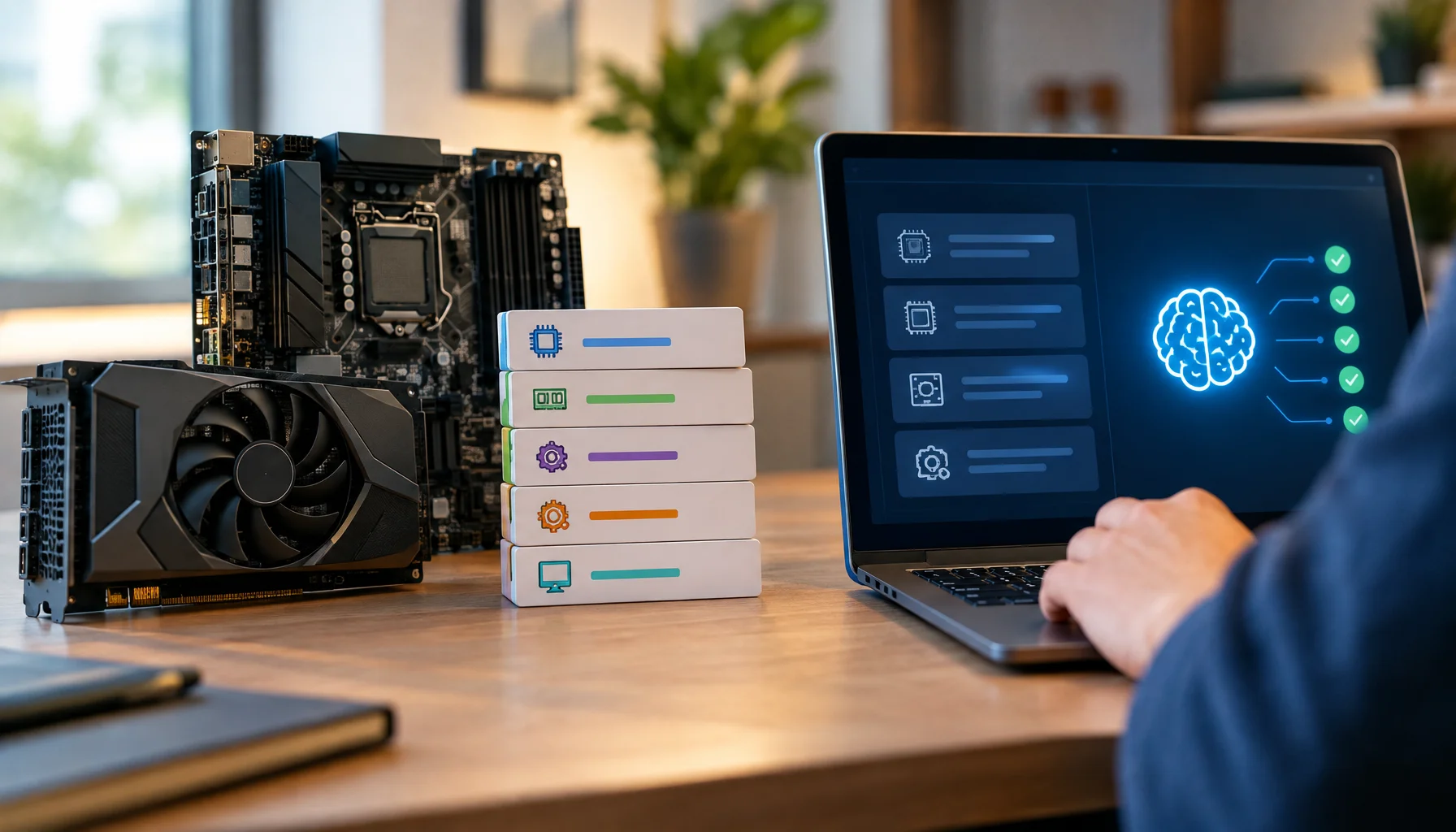
A hardware assistant can sound convincing while being wrong for a very simple reason: it knows the product family but not the exact product state.
Model names are not enough. Revisions change. Firmware changes. Driver support changes. Regional bundles differ. A specification copied from one listing may not apply to another SKU that looks almost identical.
The Core Problem
Many AI answers collapse three different things into one: stable product knowledge, current product state and seller-specific offer data. That is dangerous for compatibility decisions.
A safer hardware decision path
A Simple Example
A graphics card may share the same marketing name across several board designs. The GPU model may be identical, while length, power connector placement, cooler thickness and BIOS limits differ. Asking whether 'the RTX model' fits a case is therefore not precise enough.
The correct question is whether a resolved board variant, with known dimensions and connector geometry, satisfies the case clearance and power requirements.
More Context Can Make This Worse
If an AI receives five product pages, two forum posts and an old datasheet, it may synthesize a clean answer from contradictory evidence. The answer becomes more fluent without becoming more reliable.
What the Data Model Needs
| Layer | Example |
|---|---|
| Canonical product | GPU family and manufacturer model |
| Variant | Exact board revision / memory configuration |
| Offer | Seller-specific listing, price and warranty |
| State | Driver, firmware and current support |
| Compatibility | Case clearance, PSU, connector, OS |
| Evidence | Source, timestamp, status and conflicts |
3D as Decision Input
A 3D product model is useful only when it participates in reasoning. Bounding boxes, connector positions, mounting points and ventilation zones can become machine-readable constraints instead of decorative product viewers.
That allows questions such as: does the GPU physically fit, does the connector collide with the side panel, and is required ventilation clearance still available?
The Role of an AI Agent
The AI is strongest at interpreting requirements and explaining trade-offs. It should not be responsible for inventing dimensions, guessing revisions or silently choosing between contradictory sources.
What Would Change the Answer?
A new firmware version, a different regional SKU, an updated driver, a different case revision or a changed power requirement may invalidate the previous result. The decision should therefore carry a validity boundary rather than being treated as permanent knowledge.
Conclusion
The next generation of hardware assistants will not become trustworthy simply by adding a larger model or a bigger context window. They need versioned product identity, explicit evidence and deterministic compatibility rules first. The model should explain the decision, not manufacture the facts behind it.