
When Gaming AI Sounds Right but Isn't: The Reasoning Problem Behind Game Assistants and Agents
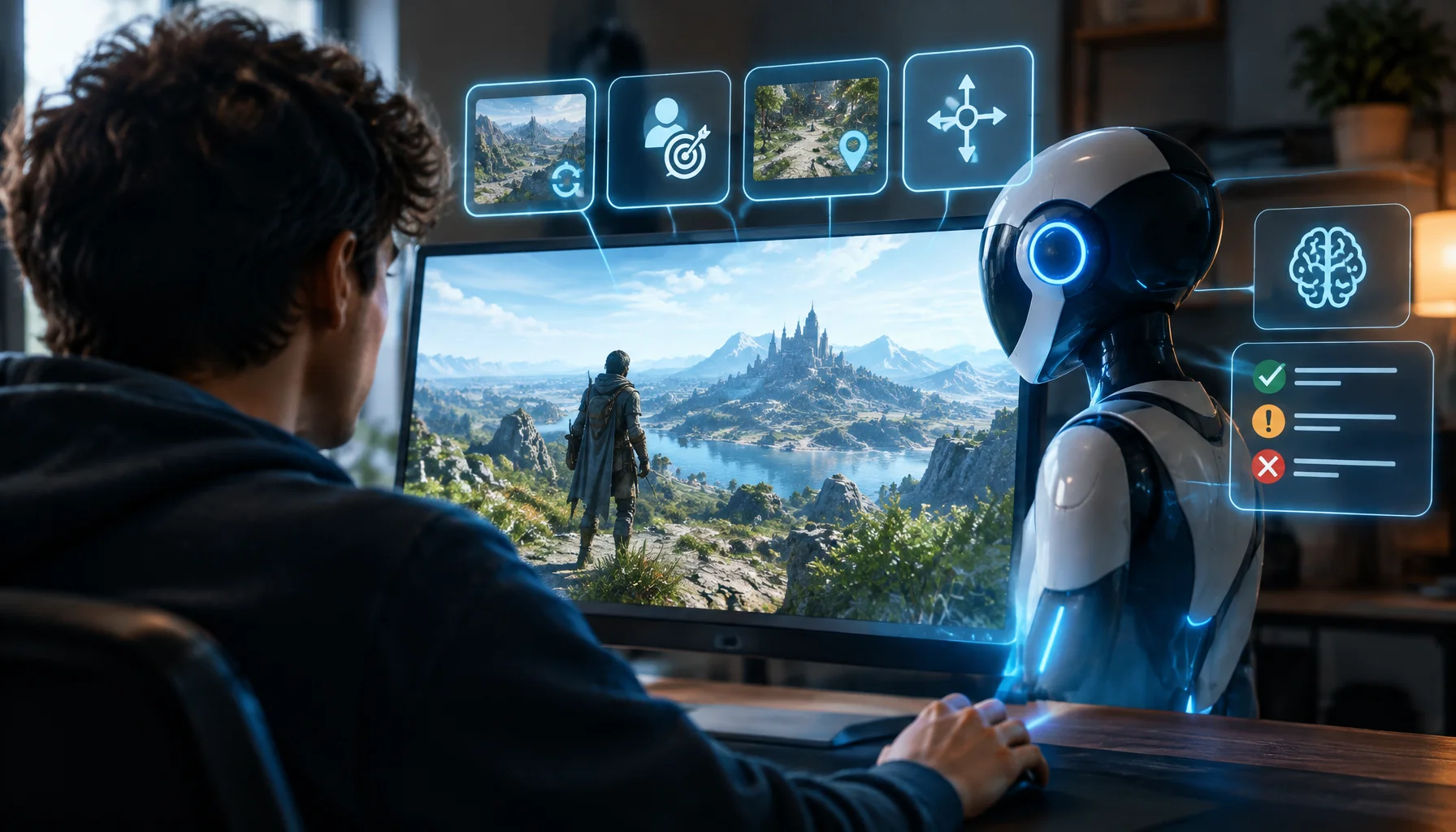
Gaming has used artificial intelligence for decades. Enemy behaviour, pathfinding, tactical decisions and non-player characters have long depended on systems designed to create the appearance of intelligent behaviour.
Generative AI changes the problem.
A modern gaming AI may not simply select an action from a predefined behaviour tree. It can interpret natural language, inspect game state, retrieve game knowledge, reason about a player's objective, generate dialogue and eventually perform actions inside the game.
The moment gaming AI moves from selecting predefined behaviour to interpreting the world, its reasoning becomes part of the gameplay system.
That creates an important new problem: an AI can produce a convincing gaming answer without having established that the answer is actually correct for the current game, patch, platform, mode, player or situation.
Gaming AI Is Becoming an Agent
The transition is already visible across current AI research and commercial gaming technology.
Google DeepMind's SIMA 2 combines a Gemini reasoning model with perception and action in 3D virtual environments. The agent can interpret higher-level instructions, reason about goals, communicate its intentions and execute actions in games, including environments it has not encountered during training.
NVIDIA ACE is moving in a similar direction from the game-engine side. Its gaming stack combines language, speech, perception, contextual knowledge and action to support conversational NPCs, autonomous characters and game assistants.
KRAFTON's PUBG Ally demonstrates how concrete this architecture has become. The system combines live game context with a small language model running locally on the player's GPU. Fast reflex-level behaviour remains handled separately while the language model manages higher-level reasoning, player coordination and communication.
Microsoft's Muse research goes in another direction: world models that learn relationships between game visuals and player actions, allowing gameplay sequences and interactive environments themselves to be generated or predicted.
These systems solve different problems, but they point toward the same structural change:
Gaming AI is moving from scripted reaction toward perception → reasoning → decision → action.
Games Are a Difficult Reasoning Environment
At first glance, answering questions about a game may appear easier than reasoning about the physical world. The environment is artificial. Its rules were created by developers.
In practice, modern games create a surprisingly hostile environment for general-purpose language models.
- Patches change facts. Weapon damage, cooldowns, maps, quests and mechanics can change while older information remains widely available online.
- Different platforms can behave differently. PC, console and mobile editions may not share identical mechanics or update schedules.
- Game modes change the problem. A strong PvE build may be a poor PvP build.
- DLC, seasons and expansions alter context. Advice can be correct for one content state and wrong for another.
- Mods change the rules entirely. An AI that does not know the mod state may reason from a game that effectively no longer exists.
- Player goals differ. Maximum damage, survivability, speedrunning, accessibility and casual enjoyment are different optimization targets.
- Game state matters. The correct action may depend on position, inventory, cooldowns, teammates, enemies and events visible only at that moment.
- Community knowledge is not automatically ground truth. Frequently repeated explanations can still be incomplete or wrong.
The problem is therefore not simply whether the model knows the game.
The model must know which version of the game its knowledge describes and whether that knowledge applies to the situation currently being evaluated.
The Dangerous Word: Best
Consider one of the most common gaming questions:
What is the best build?
An AI can easily answer this question.
That does not mean the question was sufficiently defined.
Best for what?
- Maximum theoretical damage?
- Average real-world damage?
- Solo play?
- Cooperative play?
- PvP?
- A specific boss?
- A beginner?
- A highly skilled player?
- Low equipment investment?
- Fast progression?
- Maximum survivability?
If the AI silently chooses one of these objectives, it can produce an internally coherent answer to a question the player never actually asked.
This is a gaming version of a broader AI reasoning problem: the original prompt can contain hidden assumptions that shape the answer before evidence is evaluated.
A Confident Answer Can Still Be a Framed Answer
Now consider a more specific question:
Why is this weapon worse after the latest patch?
The prompt already contains a conclusion: the weapon became worse.
A highly compliant AI may immediately search for explanations: reduced damage, changed scaling, increased recoil, weaker synergy or stronger competing weapons.
But another question should come first:
Did the weapon actually become worse under the player's relevant conditions?
Perhaps raw damage was reduced while another mechanic was improved. Perhaps the patch changed an interaction rather than the weapon. Perhaps the player's build changed. Perhaps the perceived difference is caused by a new enemy type.
The distinction matters because language models are exceptionally good at constructing explanations around propositions that already appear inside the prompt.
Game Knowledge Needs Provenance
A reliable game assistant should know not only a fact but where that fact came from.
For gaming information, useful evidence can include:
- official patch notes;
- game data or exposed statistics;
- developer documentation;
- current in-game state;
- reproducible testing;
- trusted community measurements;
- guides and wiki documentation;
- player reports.
These sources should not automatically receive equal weight.
Official change log → measured game behaviour → interpretation is a stronger evidence chain than forum claim → repeated summary → AI answer.
The distinction becomes especially important for long-lived games where years of obsolete information remain searchable.
The Patch Must Become Part of the Question
A gaming assistant should ideally normalize a question into a richer state before reasoning.
Game + version + platform + mode + player goal + relevant build + current game state → reasoning
Not every field is necessary for every question. But the system should know which missing fields can materially change the answer.
This is fundamentally different from asking the user twenty questions before giving any help. A capable system can begin with the information already available and request additional context only when it changes the reasoning outcome.
From Facts to Competing Explanations
Consider a player reporting:
My FPS suddenly drops during large fights.
A weak AI answer may recognize a familiar pattern and immediately recommend reducing GPU settings.
A stronger reasoning process creates competing hypotheses:
- H1: the GPU becomes the bottleneck;
- H2: the CPU becomes the bottleneck as simulation complexity increases;
- H3: VRAM pressure causes asset-management stalls;
- H4: background shader compilation or streaming causes transient drops;
- H5: a recent game or driver update introduced the regression.
The system can then search for observations that distinguish them.
Does reducing resolution improve the drop? Does GPU utilization fall while one CPU thread saturates? Is VRAM full? Did the problem begin immediately after an update?
The objective is not to generate more possible fixes. It is to eliminate explanations until the evidence identifies the likely mechanism.
Gaming AI Needs Falsification Too
For every important explanation, a gaming AI can ask a simple additional question:
What observation would make this explanation less likely?
If lowering resolution does not change the frame-rate collapse, a pure GPU-load explanation becomes weaker.
If a supposedly superior weapon loses consistently under controlled damage tests, the build claim needs revision.
If an NPC believes an enemy is behind a wall but current perception data shows an empty position, its world-state assumption should be updated rather than rationalized.
This principle is developed more formally in Falsification for AI Reasoning: From Answers to Tested Hypotheses.
Prompt Invariance Has a Gaming Version
An interesting reliability test is to ask whether the core gaming conclusion survives a meaningful change in framing.
Take the weapon example:
- Original: Why is this weapon worse after the patch?
- Blind: How did this patch affect the weapon's overall performance?
- Inverted: Is there evidence that the weapon became stronger or remained competitive after the patch?
- Adversarial: What evidence contradicts the claim that the weapon became worse?
If the same measured changes remain decisive under all four formulations, the conclusion is more robust against the player's initial framing.
If the answer changes dramatically depending on whether the prompt says 'better' or 'worse', the system has discovered a reasoning dependency that should be resolved before giving strong advice.
The broader methodology behind this test is described in Prompt Invariance: Does the Conclusion Survive the Prompt?.
An NPC Has the Same Problem — but the Cost Is an Action
For a gaming chatbot, incorrect reasoning produces bad advice.
For an autonomous game agent, incorrect reasoning produces behaviour.
A companion that wrongly assumes the player wants combat may attack. An NPC that misinterprets game state may walk into danger. A tactical assistant using stale information may recommend an impossible item or obsolete strategy.
The architecture therefore needs a stronger distinction between:
what the model thinks is happening → what the game state confirms → what action is allowed
Current gaming-agent systems already reflect parts of this separation. NVIDIA's PUBG Ally architecture, for example, separates fast behaviour-tree reactions from slower language-model reasoning and provides the model with domain-specific game context rather than expecting a general model to infer everything from conversational knowledge.
Game State Should Be Ground Truth Where Possible
A major advantage of gaming over open-world reasoning is that part of reality is machine-readable.
The game engine may know:
- the player's coordinates;
- current health;
- inventory;
- cooldowns;
- quest state;
- nearby entities;
- team state;
- current map;
- active modifiers;
- weapon statistics;
- game mode.
When this information is available, asking a language model to guess it from dialogue or screenshots is often unnecessary.
Use the model for interpretation. Use the game state for facts the game already knows.
This resembles retrieval-augmented generation, but the retrieval source is not merely a document database. It can be the authoritative runtime state of the game itself.
A Better Architecture for a Gaming AI Assistant
A reliable game assistant can therefore be structured as a pipeline rather than one unrestricted language-model call.
Player request → context normalization → live game state → versioned game knowledge → candidate interpretations → validation → answer or action
For more difficult questions, additional reasoning controls can be activated:
Question → evidence → competing hypotheses → counter-evidence → game-specific validation → confidence → response
Simple requests do not need the full process. Asking an NPC where the nearest merchant is should not initiate four independent hypothesis tests.
But when the AI is diagnosing a performance problem, recommending a competitive build, interpreting ambiguous mechanics or autonomously taking consequential actions, additional verification becomes much more valuable.
The Reasoning Depth Should Match the Gaming Risk
| Gaming Task | Reasoning Requirement |
| Simple lore or location lookup | Current game knowledge and retrieval |
| Build recommendation | Player objective, version, mode and comparative evidence |
| Performance diagnosis | Competing technical hypotheses and discriminating tests |
| Quest or puzzle assistance | Current state, spoiler constraints and validated progression |
| AI teammate | Live game state, goal reasoning, action constraints and rapid feedback |
| Autonomous NPC | Perception, memory, world-state validation, planning and guardrails |
| QA or testing agent | Reproducibility, state tracking, anomaly detection and evidence capture |
This avoids the opposite mistake: making every game interaction computationally expensive in the name of reliability.
The goal is not maximum reasoning everywhere. It is sufficient reasoning where being wrong actually matters.
AI Can Change Game Guides Too
The same methodology matters outside the game engine.
Traditional game guides are documents. An AI guide can become contextual.
Instead of publishing one universal build, an AI system can reason from the player's current state:
- your current equipment;
- your available resources;
- your progression stage;
- your preferred play style;
- the current patch;
- the activity you are preparing for.
That is much more powerful than a static tier list.
It is also much easier to get subtly wrong.
A personalized answer amplifies both the benefit of correct context and the cost of incorrect assumptions.
Games May Become an Important AI Reasoning Laboratory
There is another reason gaming AI matters beyond entertainment.
Games provide complex environments containing perception, spatial reasoning, planning, language, uncertainty, long-term goals and interaction with other agents — while still offering much more controlled evaluation than the physical world.
DeepMind explicitly uses games and virtual 3D environments as research environments for increasingly general agents. SIMA 2, for example, is evaluated on its ability to understand high-level goals, transfer concepts across environments and execute multi-step behaviour in games it has not previously encountered.
That makes gaming relevant not only as an application domain for AI but also as a laboratory for studying how agents perceive, reason and act.
From Gaming Problem to General AI Methodology
The problem described here is not unique to games.
Gaming simply makes it particularly visible.
A player's question can frame the answer. A patch can invalidate previous knowledge. Missing state can change the correct action. A plausible explanation can survive because nobody searched for evidence against it.
The same reasoning failures appear in research, software engineering, architecture, strategy and technical diagnosis.
I developed the broader methodology behind these ideas separately on stajic.de in From Research Protocol to a General AI Reasoning Framework.
The core idea is simple:
A good AI system should not merely generate a convincing answer. It should know what the answer had to survive before becoming a conclusion.
What Reliable Gaming AI Should Know
The most useful future gaming AI may therefore be defined less by how naturally it talks and more by how reliably it understands its epistemic position.
- What game version am I reasoning about?
- Which facts come directly from the current game state?
- Which information came from documentation or retrieval?
- Which parts of my answer are assumptions?
- What does the player actually want to optimize?
- What plausible alternative explanation exists?
- What evidence would prove my current explanation wrong?
- How certain should I be before recommending or performing an action?
Those questions are less spectacular than an NPC generating unlimited dialogue.
They may ultimately matter more.
The future of gaming AI is not only characters that can talk. It is agents that can distinguish what they know, what they assume and what the game can actually prove.
Current Gaming AI Context
Several current projects illustrate the transition described in this article. Google DeepMind's SIMA 2 integrates Gemini reasoning with perception and action across 3D virtual environments. NVIDIA ACE provides technologies for conversational and autonomous game characters, including local inference, contextual retrieval and action-oriented agent workflows. KRAFTON's PUBG Ally combines a small local language model with game-specific context and a separate fast-response behaviour system. Microsoft Research's Muse and WHAM investigate world models capable of generating or predicting gameplay from visual state and controller actions.
These systems have different objectives and should not be treated as implementations of the reasoning methodology proposed here. They demonstrate the broader architectural shift that makes the problem relevant: generative models are increasingly becoming active components of game-world interpretation and behaviour rather than external text generators.
Selected References
- Google DeepMind — SIMA 2: An Agent that Plays, Reasons, and Learns With You in Virtual 3D Worlds, 2025.
- NVIDIA — ACE for Games and NVIDIA Game Agent SDK documentation.
- NVIDIA / KRAFTON — How KRAFTON Built PUBG Ally, a Co-Playable Character Powered by NVIDIA ACE, 2026.
- Microsoft Research — World and Human Action Models towards gameplay ideation / Muse.
- Microsoft Research — MaaG: A New Framework for Consistent AI-Generated Games, 2025.
Go Deeper: AI Reasoning Methodology
For the complete domain-independent methodology behind evidence separation, competing hypotheses, Prompt Invariance, falsification and confidence calibration, continue with From Research Protocol to a General AI Reasoning Framework on stajic.de.
Related Articles
Simon - number 78
The Simon amiibo from the Super Smash Bros. Series represents the playable fighter Simon Belmont as introduced in Super Smash Bros. Ultimate. It is a character-based NFC figure with gameplay functionality. In practical terms, it is a physical data carrier that can store and transfer fighter data into compatible Nintendo systems. No mysticism, just a plastic figure with a chip.
The Ultimate Category 23 Guide: Mastering Advanced Techniques for Optimal Performance
This comprehensive guide to Category 23 explores its core principles, practical applications, and step-by-step strategies for achieving superior results in competitive environments. Whether you're a beginner or expert, discover how to leverage Category 23 to outperform standards in Category 20 contexts.
Mastering Hand and Wrist Grip, Tension, and Device Choice to Prevent Fatigue
Discover how optimal grip techniques, reduced muscle tension, and smart device selection can transform your daily computing into a fatigue-free experience. This guide provides actionable strategies to safeguard your hands and wrists from strain.
Snake - number 75
The Snake amiibo from the Super Smash Bros. Series extends the training and personalization systems of Super Smash Bros. Ultimate. It represents Solid Snake in his crossover appearance and functions as a trainable Figure Player. The practical value lies in persistent character data, stored behavior patterns, and small functional bonuses in compatible Nintendo titles.
Hero - number 84
The Hero amiibo from the Super Smash Bros. Series represents the default Hero as he appears in Super Smash Bros. Ultimate. It is a physical NFC figure that can store gameplay data and interact with compatible Nintendo systems. In simple terms, it is both a collectible and a functional in-game character replica. The added value lies in its ability to create and train a Figure Player (FP) that develops over time through player interaction.
Terry - number 86
The Terry amiibo from the Super Smash Bros. Series represents a playable fighter figure with NFC functionality. It is a physical character model combined with a data chip. In practical terms, it can store training data and interact with compatible Nintendo games. It is not a decorative statue alone, and not a passive collectible. It functions as a writable and readable figure within supported titles.
Byleth - number 87
The Byleth amiibo from the Super Smash Bros. Series extends the character beyond the screen. It functions as a physical interface between figure and software. The integrated NFC chip allows compatible Nintendo systems to read and, in specific cases, write data. It is both a collectible object and a storage medium.
amiibo Deals – Price Drops, Regional Differences and Buying Strategies
amiibo are NFC-based character figures introduced in 2014. Retail price at launch is usually fixed within a narrow range defined by Nintendo. Over time, however, price movement happens. Some figures drop below retail. Others return to standard pricing after reprints. This overview documents where notable deals appeared in the past, where they are typically possible, and how buyers approach lower pricing in practice.
Young Link - number 70
The Young Link amiibo from the Super Smash Bros. Series represents the child version of Link as he appears in Super Smash Bros. Ultimate. It is a functional NFC figure that interacts with compatible Nintendo systems. Beyond its physical presence as a collectible, its main value lies in gameplay interaction, data storage, and character training within supported titles.
Pyra - number 92
The Pyra amiibo from the Super Smash Bros. Series represents Pyra as she appears in Super Smash Bros. Ultimate. It is an NFC figure with internal storage. In plain terms, supported games can read it, and some can also write data back to it. The value is practical: it can carry saved fighter data and it can trigger unlock checks where a game supports amiibo features.
Sephiroth - number 90
The Sephiroth amiibo from the Super Smash Bros. Series expands the character’s functionality within compatible Nintendo software. It is a physical NFC-based figure that interacts primarily with Super Smash Bros. Ultimate. Beyond being a display object, it stores combat data and develops over time through player interaction.
Sealed amiibo Collecting: Notes on Packaging, Storage, and Preservation
amiibo figures appeared in stores with blister packaging that was clearly meant to be opened. Many collectors still kept them sealed. Over time this became a visible sub-category inside the broader amiibo collecting scene. Shelves with untouched cards, plastic still tight, sometimes slightly bent from storage. It is a familiar sight now.