
Render Less, Infer More: Is AI Breaking the Traditional Gaming Hardware Upgrade Cycle?
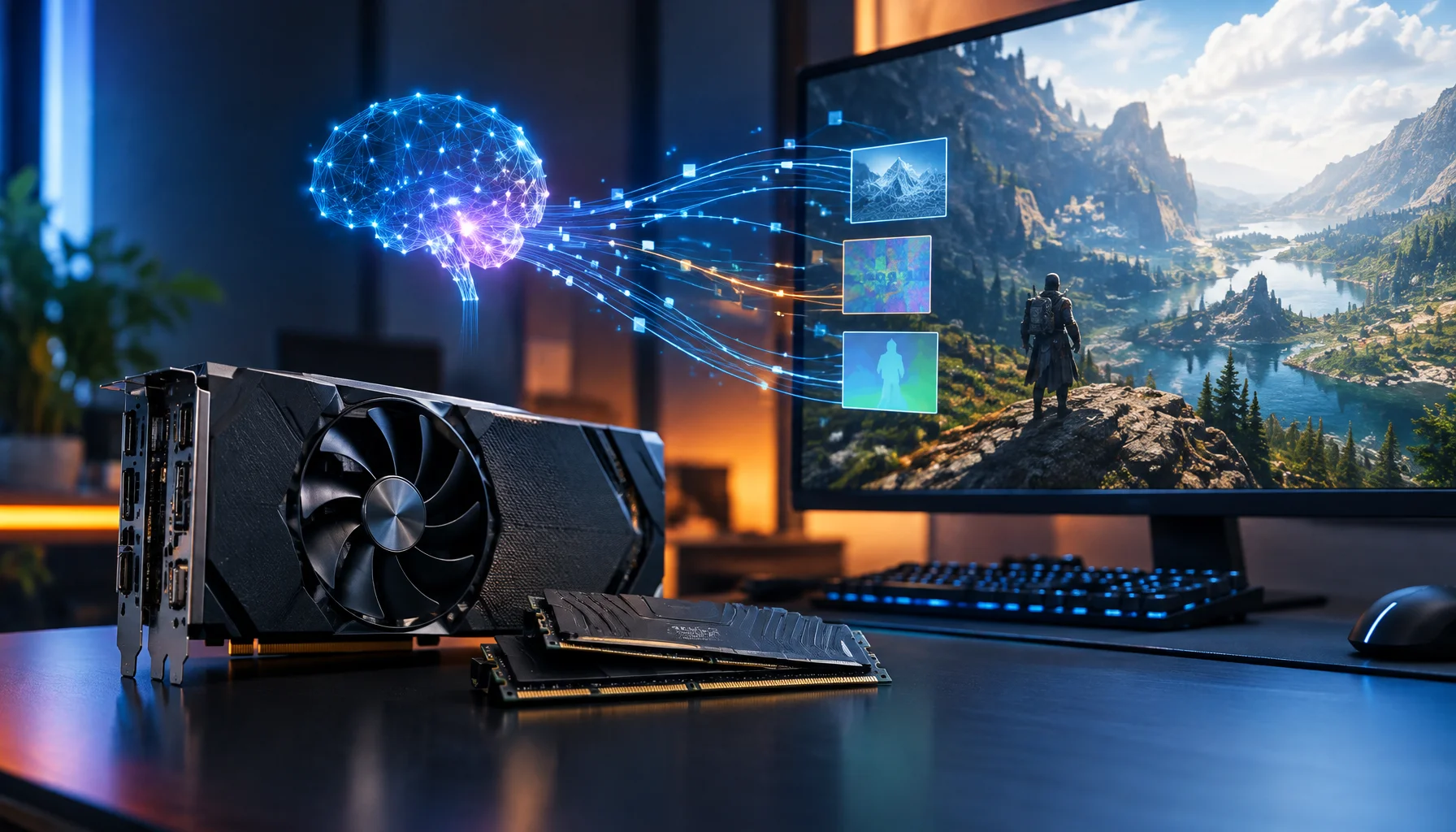
For decades, enthusiast PC gaming followed a familiar bargain: games asked for more compute, GPU generations delivered more compute, and players upgraded when the gap became large enough. That loop never worked perfectly, but the direction was understandable. In 2026, the loop is becoming harder to read because two changes are happening at the same time: AI infrastructure is competing aggressively for silicon and memory, while AI techniques are moving directly into the way games create frames.
The scale mismatch is already visible
Newzoo forecasts the global games market at $213.9 billion in 2026, up 6.1% year over year. The Semiconductor Industry Association reported $791.7 billion in global semiconductor sales for 2025, up 25.6%, and projected roughly $1 trillion for 2026. The games business and semiconductor business still depend on each other, but their incentives are becoming less symmetric: the same advanced manufacturing ecosystem that enables premium gaming now serves AI and data-center buyers with much larger infrastructure budgets. These are not directly comparable product categories; they establish the scale of the upstream compute economy around gaming.
| Reference point | Reported or forecast value | Why it matters here |
|---|---|---|
| Global games market, 2026 forecast | $213.9B, +6.1% YoY | Large consumer entertainment market, but downstream of advanced hardware supply |
| PC games, 2026 forecast | $45.9B, +5.3% YoY | The gaming segment most directly exposed to PC component economics |
| Global semiconductor sales, 2025 | $791.7B, +25.6% YoY | Shows the scale of the upstream industry serving gaming, AI, mobile, automotive and cloud |
| Global semiconductor industry, 2026 projection | ~$1T | Raises the opportunity cost of dedicating premium silicon only to consumer gaming |
Memory is where the pressure becomes concrete
TrendForce has repeatedly reported that DRAM suppliers are shifting capacity toward server and HBM products as AI demand grows. In March 2026 it forecast conventional DRAM contract prices rising 58–63% quarter over quarter in Q2 and said limited GDDR allocation was constraining graphics memory supply. By Q3, TrendForce said consumer customers were reaching an affordability limit even as AI and server demand remained strong.
The resource-allocation pressure
At exactly the same time, the frame itself is changing
Microsoft now describes machine learning as becoming foundational to real-time graphics. DirectX is adding shader-level and model-level ML paths so neural texture compression, denoising, super resolution and other learned workloads can sit inside the graphics stack instead of being bolted on as isolated features. NVIDIA's DLSS 5 research pushes the idea further by introducing a generative neural rendering stage that complements conventional rendering with learned appearance priors. Neural rendering does not mean conventional rendering disappears. The emerging model is hybrid: render some information directly, infer or reconstruct other information when doing so is cheaper or more useful.
Traditional scaling vs neural-era scaling
| Traditional path | Neural-era path | |
|---|---|---|
| More visual fidelity | Store more detail and render more work | Store/render selectively, reconstruct or infer some detail |
| Memory response | Add capacity and bandwidth | Add capacity where needed, but also compress and reduce movement |
| Performance response | More shader/RT throughput | Mix shader, RT and matrix/Tensor-style compute |
| Software role | Engine schedules mostly conventional graphics work | Engine increasingly schedules rendering, data movement and ML workloads |
The 5090 question is useful only if we phrase it correctly
The RTX 5090 is a useful example precisely because the evidence is mixed. As of October 18, 2026, NVIDIA still lists the GeForce RTX 5090 as a current product. At the same time, retailer behavior and press reports have documented unusually poor availability and unconfirmed claims of a production halt. That is a market signal, not an official end-of-production announcement. The defensible question is therefore not whether NVIDIA secretly killed one card, but whether the opportunity cost of allocating top-tier Blackwell-class silicon to enthusiast gaming rises when similar architecture can serve professional visualization and AI markets with very different economics.
Memory is starting to become a compute problem, not only a capacity problem
There are at least four ways to attack a memory bottleneck without simply increasing raw DRAM speed: compress the representation, reconstruct detail with compute, predict what data will be needed next, and keep the right data resident close to the execution unit. None of these makes a physical memory chip magically faster. They change how much useful work the system obtains from a finite capacity and bandwidth budget.
| Technique | What changes | What does not change automatically |
|---|---|---|
| Compression | Fewer physical bytes represent the same logical data | The DRAM clock and bus width |
| Neural reconstruction | Some detail is generated from a compact representation | The cost disappears; inference has its own compute/latency cost |
| Predictive prefetch | Data arrives before the requesting workload stalls | Total physical bandwidth |
| Residency / unified access | Less unnecessary migration or duplication | Contention and latency constraints |
How the technical response could work
One possible future frame pipeline
This pipeline is not one announced product. Every component already exists in some form, but the integrated chain is the hypothesis. Neural texture compression has shown that learned representations can exchange compute for memory. GPU prefetch research has shown that learned prediction can improve memory-page hit rates. DirectX is formalizing ML inside the graphics programming model. DLSS 5 shows a generative stage entering real-time rendering.
A game has one advantage general workloads often do not: it already knows part of its future
A game engine knows the camera transform, player velocity, current world cell, neighboring streaming cells, animation state, active entities, LOD transitions, shader dependencies and often likely traversal paths. That deterministic context does not reveal the future perfectly, but it gives a predictor a richer starting point than a generic memory trace alone.
A predictive gaming-memory example
Why a Spark-like architecture becomes interesting
DGX Spark is not a gaming PC, and treating it as one would hide the useful lesson. Its GB10 design combines Arm CPU cores, a Blackwell GPU, Tensor and RT hardware, and up to 128 GB of coherent unified system memory. That architecture asks a different question from a classic desktop: instead of splitting the system cleanly into CPU memory and discrete VRAM, what happens when multiple compute engines share a large memory pool?
| Property | DGX Spark reference | Gaming implication if the principle were adapted |
|---|---|---|
| Memory | Up to 128 GB coherent unified LPDDR5X | Large shared pool could reduce duplication and give local AI + graphics access to common data |
| Memory bandwidth | 273 GB/s | Capacity is not enough; high-end graphics still needs aggressive bandwidth and latency management |
| Compute mix | CPU + Blackwell GPU + Tensor + RT | A future game workload could be split across more specialized engines |
| Form factor/power | Compact GB10 system | Integration can improve efficiency but may reduce modular upgradeability |
What would have to be true for this transition to work?
The Neural Gaming Viability Test
What should a buyer expect from a Spark-like transition?
Potential benefit vs real cost
| Potential gain | Cost / risk | |
|---|---|---|
| Large coherent pool | More flexible sharing between CPU, graphics and local AI | Shared clients can contend for the same bandwidth |
| Less duplication | Fewer copies between separate system-RAM and VRAM pools | Coherence and scheduling add complexity |
| More local AI headroom | Larger models, agents or neural assets can coexist locally | AI can compete with graphics for compute and memory |
| System-level optimization | The platform can optimize data placement and accelerators together | Tighter integration can reduce upgradeability and increase lock-in |
| New workload flexibility | A machine may age better if future games shift toward neural workloads | Only if engines and runtimes actually use those capabilities |
What would falsify this hypothesis?
This thesis is deliberately falsifiable. The table below defines the market, software, hardware and game-adoption signals that would make the argument stronger or weaker over time.
Evidence that strengthens or weakens the thesis
| Would strengthen it | Would weaken it | |
|---|---|---|
| Memory economics | Server/HBM priority continues to squeeze consumer allocation | Consumer capacity expands and price pressure normalizes |
| Graphics stack | ML primitives become normal engine/DirectX features | Neural graphics remains vendor-specific optional post-processing |
| Hardware design | More integrated heterogeneous compute and larger coherent memory pools | Discrete GPU + separate RAM remains clearly superior on cost, flexibility and latency |
| Game adoption | Studios ship neural compression, generation and predictive data paths broadly | Tech remains limited to demos or a few flagship games |
The practical conclusion for a gamer today
Do not buy hardware because a speculative architecture might arrive. Buy for the games, resolution, latency target and workloads you actually have. But do not assume that future-proofing can still be reduced to one number such as raster performance or VRAM capacity. The direction of the software stack suggests that memory behavior, neural compute and engine support may become increasingly important parts of the value equation.
Primary sources
Newzoo — 2026 Global Games Market Key Numbers2026 games-market forecast used for the scale comparison.
Semiconductor Industry Association — 2025 Global Sales2025 semiconductor sales and the association's roughly $1 trillion 2026 projection.
TrendForce — AI Server Demand Sustains Memory Price Increases in 4Q26Late-2026 evidence for ongoing server-priority capacity allocation and consumer pressure.
NVIDIA Research — Buddy CompressionResearch source for 2.2× HPC and 1.5× DL average compression ratios.
Deep-learning based CPU–GPU UVM prefetchingResearch source for learned page-prefetching results.
AAAI 2026 — Asynchronous KV Cache PrefetchingResearch source demonstrating latency hiding through proactive GPU-cache prefetching.
TrendForce — AI Server Demand and 2Q26 Memory PricesCurrent evidence for server/HBM prioritization, GDDR constraints and consumer pressure.
Microsoft DirectX — Evolving DirectX for the ML EraOfficial GDC 2026 overview of shader-level and model-level ML in DirectX.
NVIDIA Research — DLSS 5: Generative Neural RenderingPrimary research page describing DLSS 5 as a real-time generative rendering stage.
NVIDIA — DGX Spark SpecificationsOfficial architecture, unified memory and bandwidth specifications.
NVIDIA — GeForce RTX 5090Official current RTX 5090 product page used to distinguish confirmed product status from production-halt rumors.
Tom’s Hardware — RTX 5090 Retail Disappearance and Production-Halt RumorsCurrent market report used only as an industry signal; it explicitly notes that NVIDIA has not confirmed a production halt.
NVIDIA Research — Random-Access Neural Compression of Material TexturesPrimary source for the 4× linear resolution / 16× texel comparison at 30% less memory versus BC High.
NVIDIA — RTX PRO 6000 Blackwell Workstation EditionOfficial source for 96 GB GDDR7 and 1,792 GB/s memory bandwidth used as a bandwidth reference point.
Key concepts
- Neural rendering
- Rendering methods that use trained models as part of producing, reconstructing or enhancing visual output.
- Heterogeneous compute
- A system that assigns different workloads to different compute engines such as CPU, GPU, RT and matrix/Tensor hardware.
- Effective memory
- A practical description of how much useful data a memory system can keep and feed to compute after compression, residency and movement efficiency are considered. It is not a formal replacement for physical capacity.
- Predictive memory
- Figure Rocks shorthand for combining known game state and learned prediction to prepare likely-needed data before a stall. It is a hypothesis, not an industry standard.
Related Articles
Gaming Controls: Build Input Feel Without Hand Pain
Controls shape responsiveness and comfort. This guide focuses on ergonomics, consistency, and practical setup habits.

Google I/O 2026 and Gaming: AI, XR, and the Next Wave of Collectibles
Google I/O 2026 was not a classic gaming event, but its AI, XR, Gemini, Google Play, and creative tooling announcements point toward a clear shift in gaming culture. This article explains how AI discovery, XR companion layers, Gemini-powered media, and faster character visibility may shape games, figures, collectibles, and future fan ecosystems.
The Gaming Feel Chain: Why One Upgrade Often Does Nothing
Feel is a chain: input, system, frame pacing, sync, display, network. If one link is unstable, upgrades don’t land.
Gaming Comfort: Ergonomics That Prevent Fatigue (Long Sessions, No Pain)
Comfort is performance. Learn a practical ergonomics baseline for chair, desk, monitor, and controls to reduce fatigue and keep consistency over long sessions.
What Does “Future-Proof” Gaming Hardware Mean in the Neural Rendering Era?
Future-proofing used to mean buying more CPU, GPU and VRAM than you needed today. Neural rendering makes that rule less reliable. Here is a better decision framework.
Gaming Baseline Setup: Frame Pacing, VRR, and Latency (PC + Console)
A practical baseline that makes everything feel better before you buy anything: stable frame pacing, correct VRR, and reduced latency for PC and consoles.
QoS Myths for Gaming: What Helps, What Hurts, and the Real Priority
QoS is not a magic ‘gaming’ toggle. Good queue management reduces latency under load. Bad QoS adds jitter or breaks fairness. Here’s the stable way to think about it.
Queue Management for Gaming: Stop Bufferbloat Spikes Under Load
Bufferbloat is why your game feels heavy when someone uploads or streams. Learn the practical order: measure under load, manage queues, then upgrade hardware.
amiibo Hub: Start Here (Pillars, Guides, and What to Buy First)
Your Amiibo library in one place: basics, compatibility, buying, and collecting. Use this hub to choose your path and avoid beginner mistakes.
Experience-First Gaming: The Anti-Race Handbook
A pillar guide for players tired of the spec race. Build feel, stability, and taste: better play, calmer upgrades, long-term value.
MTU Myths for Gaming: When Changing MTU Helps (Rare) vs Breaks Things
MTU tweaks are usually placebo and can cause fragmentation issues. Learn when MTU changes are actually relevant and a safe approach if you must test.
Gaming Audio Positioning: Clarity Beats Bass (Headset Setup That Works)
Competitive audio is about information: footsteps, direction, distance, and timing. Learn a practical headset baseline and the mistakes that kill positioning.