
Why AI Is Reshaping Gaming Memory: HBM, GDDR, VRAM and the Fight for Capacity
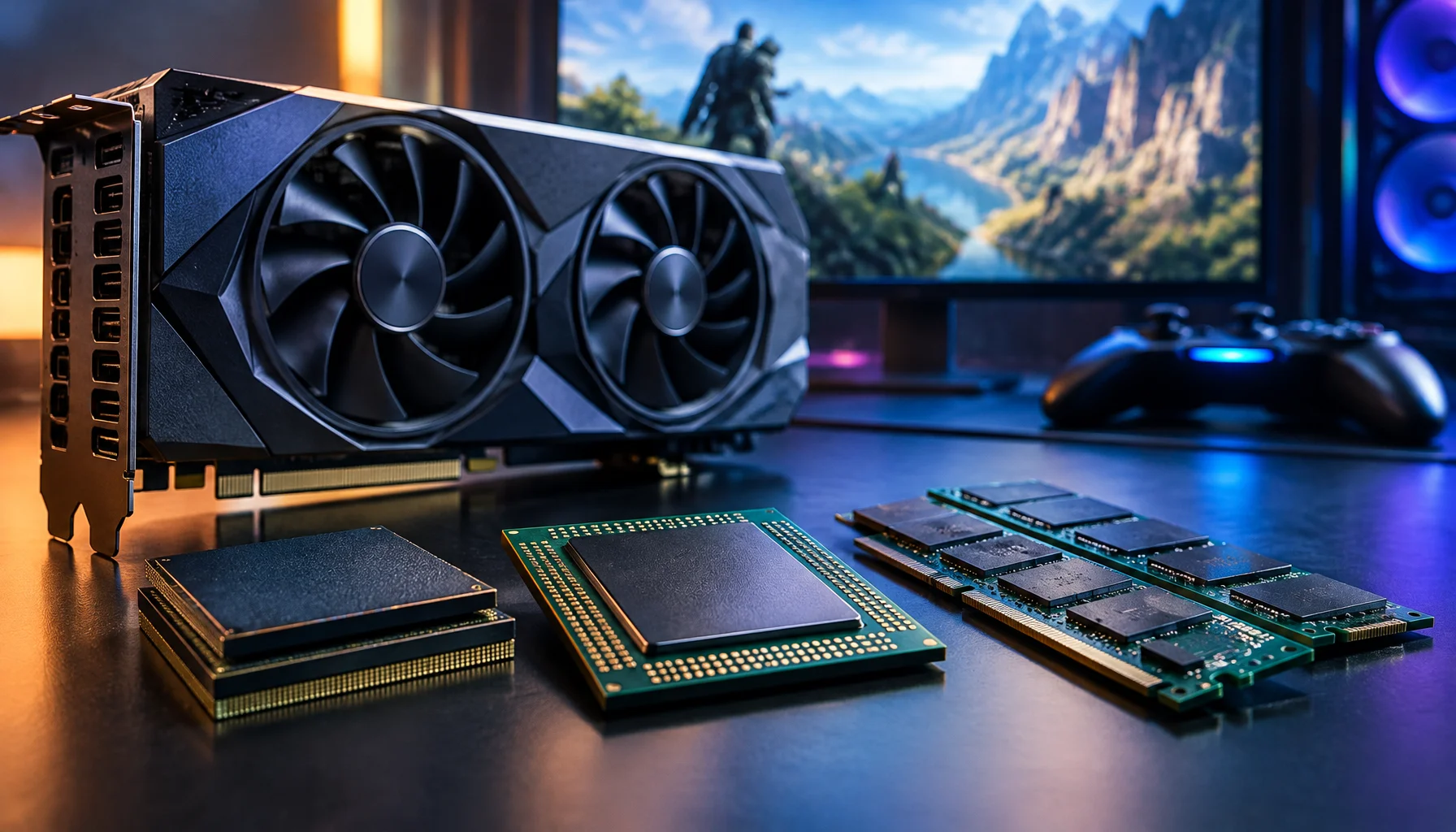
A modern gaming PC can have enough GPU compute and still be constrained by memory capacity, bandwidth, residency or price. In 2026, those technical questions are colliding with a market problem: memory suppliers are increasingly serving AI and server buyers whose demand reaches far beyond gaming VRAM.
The market signal: server demand is getting priority
TrendForce reported in March 2026 that DRAM suppliers were reallocating capacity toward HBM and server applications and that graphics DRAM supply remained constrained by limited GDDR allocation. By Q3 it said consumer customers were reaching affordability limits even as AI and server demand remained strong. On September 30, 2026, TrendForce still described suppliers as prioritizing advanced-process capacity for high-performance server products and projected another 10–15% QoQ rise in conventional DRAM contract prices for Q4. The important point is persistence: the pressure is visible late in 2026, not only in an early-year shortage snapshot.
| Signal | Reported 2026 condition | Gaming consequence |
|---|---|---|
| Conventional DRAM pricing | 58–63% QoQ forecast for Q2 | Raises system-memory cost pressure across PCs |
| Graphics DRAM | Limited GDDR allocation | Constrains the memory pool used by gaming GPUs |
| Server/AI memory | Suppliers prioritize high-value server products | Consumer products compete against stronger demand |
| Consumer affordability | TrendForce says PC/smartphone buyers reached limits by Q3 | Vendors cannot pass through infinite memory cost without losing volume |
| Late-2026 capacity allocation | Advanced-process capacity still prioritized for high-performance servers; conventional DRAM +10–15% QoQ projected for Q4 | Shows that the structural allocation pressure had not disappeared by September 2026 |
HBM and GDDR are not interchangeable
Different memory jobs
| HBM | GDDR | DDR/LPDDR | |
|---|---|---|---|
| Typical placement | AI/HPC accelerators and some specialized compute | Discrete graphics cards and consoles depending on design | System memory; LPDDR also used in integrated/unified designs |
| Primary strength | Very high aggregate bandwidth near large accelerators | High graphics bandwidth with discrete GPU economics | Cost/capacity/flexibility for general system memory |
| Gaming relevance | Indirect today through market competition and architecture lessons | Direct VRAM path for discrete gaming GPUs | CPU/system working set; unified designs may share it with graphics |
The important market connection is therefore not 'AI uses HBM, so games lose HBM.' It is that suppliers optimize fabs, advanced nodes, packaging, engineering and product mix across a portfolio. When server and AI products command strong demand, the opportunity cost of serving low-margin consumer segments rises.
Why VRAM capacity alone is a weak metric
A 16 GB card is not automatically safer than a 12 GB card in every game, and a full VRAM meter is not proof that the game requires every allocated byte. The useful distinction is between allocation, working set, residency pressure and bandwidth. Capacity tells you what can fit. Bandwidth tells you how quickly data can move. Residency policy tells you what is actually kept close to the GPU.
The gaming memory pressure chain
Compression changes effective capacity, not the DRAM clock
This distinction matters because neural compression is often described too loosely. NVIDIA's neural texture compression research demonstrated 16× more texels than a low-resolution BC High comparison at a similar storage budget while using 30% less memory in the illustrated setup. That does not make GDDR physically faster. It changes how much useful visual information can be represented inside a given storage and memory budget. The broader design lesson is that compute can substitute for part of a storage or memory budget when the reconstruction cost is lower than the bytes avoided.
The buyer question is changing
A better memory buying sequence
Five different “memory improvements” that should not be confused
| Metric | What improves | What does not automatically improve | |
|---|---|---|---|
| Physical capacity | GB | How much data can be resident | Bandwidth or latency |
| Raw bandwidth | GB/s | Maximum transfer rate | Prediction accuracy or working-set size |
| Effective capacity | Compression ratio | Bytes represented per physical byte | DRAM clock |
| Effective access latency | Hit rate / stall reduction | Chance data is ready before demand | Physical bandwidth ceiling |
| Working-set stability | Evictions / migrations | How consistently hot data stays available | Total installed memory |
Figure Rocks hypothesis: memory becomes a compute problem
What more memory can and cannot solve
| Can help | Cannot guarantee | |
|---|---|---|
| Larger scenes/assets can remain resident | Yes | No guarantee of higher bandwidth |
| Reduce eviction pressure when capacity is the bottleneck | Yes | No guarantee against shader compilation or CPU stalls |
| Provide headroom for larger working sets/models | Yes | No guarantee future engines will use that headroom efficiently |
| Avoid some texture-quality fallbacks | Yes | No guarantee better reconstruction or frame pacing |
What would change this analysis?
The pressure would ease if suppliers add enough consumer-oriented capacity, if AI demand grows more slowly than expected, or if price competition forces product mixes back toward consumer markets. The technical argument also changes if neural compression and engine-level memory management fail to deliver enough real-time value.
Primary sources
TrendForce — 4Q26 memory outlookLate-2026 evidence for server-priority capacity allocation and consumer pressure.
TrendForce — AI Server Demand and 2Q26 Memory PricingEvidence for HBM/server prioritization, limited GDDR allocation and consumer pressure.
NVIDIA Research — Buddy CompressionSource for effective-memory compression results and slowdown.
TrendForce — DRAM Revenue and Supply Allocation, 2Q26September 2026 report showing supply expansion lagging demand and additional supply prioritized for servers.
NVIDIA Research — Random-Access Neural Compression of Material TexturesPrimary research source for neural material-texture compression.
Gaming memory and AI demand
Is HBM replacing GDDR in gaming GPUs?
Does more VRAM always reduce stutter?
Does compression increase memory speed?
Why does AI matter to GDDR pricing?
Memory terms that should not be confused
- VRAM capacity
- The amount of graphics-addressable memory available to a discrete GPU or graphics subsystem.
- Bandwidth
- The amount of data that can be transferred per unit time, usually expressed in GB/s.
- Residency
- Which resources are kept in fast GPU-accessible memory at a given moment.
- HBM
- High Bandwidth Memory, a stacked-memory technology optimized for very high bandwidth and used heavily in accelerators.
- GDDR
- Graphics-oriented double data rate memory commonly used by discrete GPUs.
- Effective capacity
- The useful data footprint a system can support after representation and compression choices; not a replacement for physical capacity.
Related Articles

What If a Game Could Predict Its Next Memory Access? AI Prefetching and the Future of Stutter
Game engines already know where the player, camera and world are going. Research shows learned GPU prefetching can predict memory pages. What happens if those ideas are combined?
Render Less, Infer More: Is AI Breaking the Traditional Gaming Hardware Upgrade Cycle?
AI is making high-performance silicon and memory more valuable outside gaming while also giving games new ways to render, compress and predict. This analysis asks whether those two trends are converging into a new hardware model.
What Would a Spark-Like Gaming PC Actually Change? Unified Memory, AI Compute and the Classic GPU Split

Google I/O 2026 and Gaming: AI, XR, and the Next Wave of Collectibles
Google I/O 2026 was not a classic gaming event, but its AI, XR, Gemini, Google Play, and creative tooling announcements point toward a clear shift in gaming culture. This article explains how AI discovery, XR companion layers, Gemini-powered media, and faster character visibility may shape games, figures, collectibles, and future fan ecosystems.

The Game Engine Is Becoming Part Renderer, Part Scheduler, Part AI System
Game engines used to orchestrate simulation and rendering. Neural graphics, predictive memory and game agents are adding a third responsibility: deciding where inference belongs inside the frame and the game state.
What Does “Future-Proof” Gaming Hardware Mean in the Neural Rendering Era?
Future-proofing used to mean buying more CPU, GPU and VRAM than you needed today. Neural rendering makes that rule less reliable. Here is a better decision framework.