
What Would a Spark-Like Gaming PC Actually Change? Unified Memory, AI Compute and the Classic GPU Split
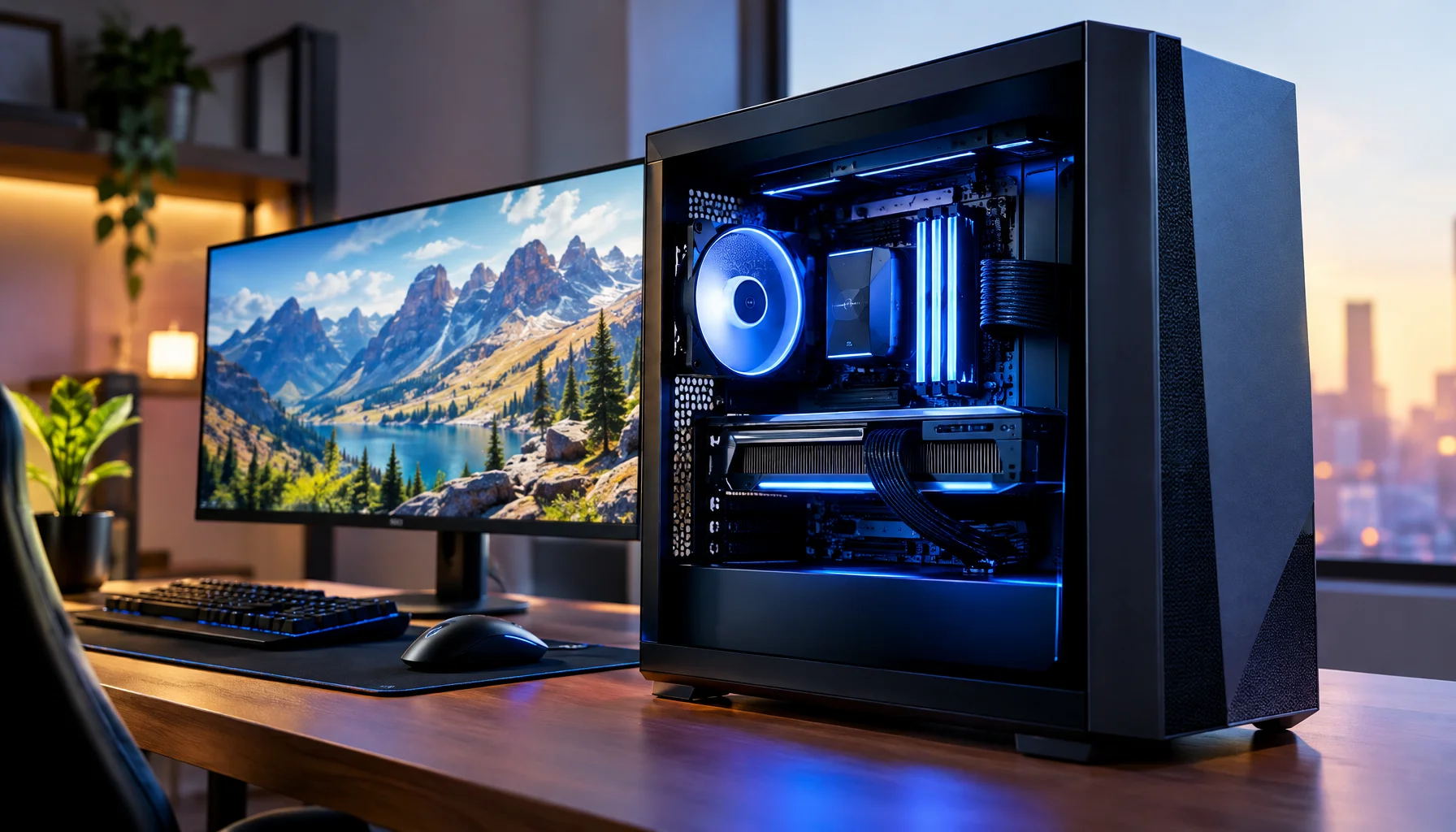
DGX Spark is built for AI development, not for replacing a GeForce gaming desktop. That is exactly why it is useful as a thought experiment. It packages CPU, GPU, Tensor and RT capability around a large coherent memory pool, making the entire system look less like a classic PC with two major memory islands and more like one heterogeneous compute machine.
What Spark actually is
| DGX Spark specification | Official value | Why it matters to this thought experiment |
|---|---|---|
| Architecture | Grace Blackwell / GB10 | CPU and Blackwell GPU are designed as one integrated compute platform |
| CPU | 20-core Arm | Breaks from the traditional x86 gaming-desktop assumption |
| System memory | 64 GB or 128 GB coherent unified LPDDR5X | Large common pool rather than separate CPU RAM + dedicated VRAM |
| Memory bandwidth | 273 GB/s | Strong for an integrated system, but well below top-end discrete graphics memory bandwidth |
| AI compute | Up to 1 PFLOP FP4 | Shows how much design priority can move toward matrix/Tensor-style workloads |
| RT hardware | 4th-gen RT cores | The SoC still includes dedicated real-time graphics acceleration |
The classic PC split creates duplication and movement
Traditional discrete-gaming data path
That separation is not inherently bad. It allows the GPU to have extremely fast dedicated memory and lets users upgrade components independently. But it also creates boundaries: capacity can be stranded on one side, data can be duplicated, and applications need explicit movement and residency policies.
A unified design changes the question
Spark-like data model
Discrete gaming PC vs Spark-like principle
| Discrete gaming PC | Spark-like integrated system | |
|---|---|---|
| Memory capacity | System RAM + separate VRAM pools | Large coherent shared pool |
| Peak graphics bandwidth | Can be extremely high with GDDR/HBM-style dedicated memory | Must be designed high enough for graphics + CPU + AI contention |
| Upgradeability | GPU, RAM and sometimes CPU replaced independently | More platform-level replacement likely |
| Local AI fit | AI competes for GPU VRAM or separate NPU | Large shared pool can make models easier to fit |
| Data movement | Explicit transfers and duplication can matter | Potentially less copying, but locality still matters |
Capacity and bandwidth tell radically different stories
| Reference architecture | Memory capacity | Memory bandwidth | Design lesson |
|---|---|---|---|
| DGX Spark | 128 GB coherent unified LPDDR5X | 273 GB/s | Huge shared capacity, but not discrete-high-end graphics bandwidth |
| RTX PRO 6000 Blackwell Workstation | 96 GB GDDR7 | 1,792 GB/s | Professional discrete GPU shows how much bandwidth high-end graphics/AI workloads can demand |
| GeForce RTX 5090 | 32 GB GDDR7, 512-bit | High-end discrete design | Gaming flagship emphasizes bandwidth and dedicated local memory over giant coherent capacity |
The point is not that one architecture is universally better. Spark demonstrates coherent capacity; the RTX PRO 6000 demonstrates extreme local bandwidth. A gaming architecture that tries to combine Spark-like coherence with flagship-class graphics would need to reconcile those priorities rather than copy one product unchanged.
Compression and prediction could make a lower-bandwidth unified pool more viable
A future integrated design does not have to solve every problem by increasing pin speed. Compression can reduce bytes moved, neural representations can reduce stored detail, predictive prefetch can hide some access latency, and a cache hierarchy can keep hot graphics data near the GPU. Those techniques do not erase the bandwidth wall, but they can reduce how often software hits it.
Why neural rendering makes unified memory more interesting
Classic graphics mostly asks whether the GPU can keep textures, geometry and buffers close enough to render the scene. Neural graphics can add model weights, latent representations, history buffers and intermediate tensors. A large coherent pool makes those new data classes easier to share between CPU-side game systems and GPU-side inference, especially when a local game assistant or NPC model is also running.
What would a gaming version need that Spark does not optimize for?
| Gaming requirement | Why Spark-like integration helps | What still must be solved |
|---|---|---|
| High-refresh graphics | Close CPU/GPU coordination | Much higher sustained graphics bandwidth and low latency |
| Large neural models | Shared capacity reduces fit/duplication problems | Inference cannot steal frame time unpredictably |
| Asset streaming | One pool simplifies residency relationships | Storage-to-memory path and decompression must stay fast |
| Competitive latency | Fewer transfers can help | Unified scheduling must not add contention or long queues |
| Long product life | Integrated platform can be power efficient | Repair/upgrade path can become worse than a modular PC |
The most interesting version is probably hybrid
A possible hybrid gaming memory hierarchy
What the buyer gains — and gives up
Buyer trade-off
| Potential gain | Potential cost | |
|---|---|---|
| Very large useful pool | Fewer hard walls between RAM, VRAM and model memory | Shared contention and less obvious performance specs |
| Local AI headroom | Bigger models can coexist with games | AI workloads can compete with rendering |
| Integration | Potential efficiency and compactness | Thermal limits may cap peak graphics performance |
| Platform simplicity | Fewer compatibility boundaries | Whole-platform upgrade instead of GPU-only upgrade |
| Optimization | Engine can coordinate more of the system | Poor software support can waste expensive hardware |
| Predictive memory management | Fewer late asset/page arrivals when prediction is accurate | Wrong predictions can waste bandwidth, residency and cache |
| Platform-level optimization | Engine, driver and hardware can coordinate data placement and accelerators more deeply | Greater ecosystem lock-in and more opaque performance behavior |
What would falsify the idea?
If high-end discrete GPUs continue to deliver much better cost, bandwidth and latency while local gaming AI remains optional, there may be little reason to accept the lock-in and contention of a unified architecture. The hypothesis becomes stronger only if games increasingly need large shared data sets and neural workloads that are awkward to fit inside a traditional CPU-RAM + discrete-VRAM split.
Primary source
NVIDIA DGX Spark — Official specificationsOfficial GB10 architecture, unified memory, bandwidth, CPU, GPU and AI-compute specifications.
NVIDIA — RTX PRO 6000 Blackwell Workstation EditionOfficial 96 GB GDDR7 and 1,792 GB/s bandwidth reference for a high-end discrete Blackwell GPU.
Spark-like gaming architecture
Is DGX Spark a gaming PC?
Would 128 GB unified memory beat a 32 GB high-end GPU?
Why is unified memory attractive for gaming AI?
What is the biggest risk?
Could a hybrid be better?
Architecture terms
- Coherent unified memory
- A memory architecture where multiple processors can access a shared system memory space with coherence guarantees.
- Memory tier
- A layer in a hierarchy with different capacity, bandwidth and latency characteristics.
- Heterogeneous compute
- Using different processor types or accelerator blocks for different workload classes.
- Spark-like gaming architecture
- Figure Rocks shorthand for borrowing integrated CPU/GPU/AI and coherent-memory principles from systems such as DGX Spark; not an announced product.
Related Articles
Pre-Order Alert: Good Smile Company Figma Doom: The Dark Ages – Doom Slayer DX Edition
The new Good Smile Company Figma Doom: The Dark Ages Doom Slayer DX Edition is more than a routine figure drop. It connects collector demand, franchise identity, and the wider appeal of Doom as one of gaming’s most durable icons.
Why AI Is Reshaping Gaming Memory: HBM, GDDR, VRAM and the Fight for Capacity
The memory problem behind modern gaming is no longer only about how many gigabytes a GPU needs. AI infrastructure is changing which memory products suppliers prioritize and how much consumer buyers can afford.
HDR Tone Mapping Traps: When ‘Dynamic’ Settings Destroy Detail
Many HDR problems are tone mapping problems. ‘Dynamic’ modes can crush highlights or lift blacks into gray fog. Use this baseline to keep detail readable.

The Game Engine Is Becoming Part Renderer, Part Scheduler, Part AI System
Game engines used to orchestrate simulation and rendering. Neural graphics, predictive memory and game agents are adding a third responsibility: deciding where inference belongs inside the frame and the game state.
All amiibo-Compatible Games – Complete Overview of Bonuses and Gameplay Integration
amiibo figures interact with a wide range of Nintendo games across Wii U, Nintendo 3DS, and Nintendo Switch. The added value differs from title to title. In some cases the bonus is cosmetic. In others it affects gameplay more directly. What follows is a structured overview of compatible titles and the most significant unlock tied to scanning a figure.

Google I/O 2026 and Gaming: AI, XR, and the Next Wave of Collectibles
Google I/O 2026 was not a classic gaming event, but its AI, XR, Gemini, Google Play, and creative tooling announcements point toward a clear shift in gaming culture. This article explains how AI discovery, XR companion layers, Gemini-powered media, and faster character visibility may shape games, figures, collectibles, and future fan ecosystems.
Render Less, Infer More: Is AI Breaking the Traditional Gaming Hardware Upgrade Cycle?
AI is making high-performance silicon and memory more valuable outside gaming while also giving games new ways to render, compress and predict. This analysis asks whether those two trends are converging into a new hardware model.
What Does “Future-Proof” Gaming Hardware Mean in the Neural Rendering Era?
Future-proofing used to mean buying more CPU, GPU and VRAM than you needed today. Neural rendering makes that rule less reliable. Here is a better decision framework.
Upcoming Nintendo amiibo – New Figures, Release Windows and Functional Significance
amiibo are physical figures equipped with NFC chips that communicate with Nintendo consoles. They unlock in-game items, cosmetic elements, or small gameplay functions in compatible titles. This catalog overview focuses on officially announced upcoming amiibo, their expected release windows, their functional value, and their position within the broader wave structure.
Beyond Scanning – Creative Uses and Modifications of amiibo"
amiibo are NFC-equipped character figures released by Nintendo since 2014. Technically, they are small data carriers inside molded plastic figures. In practice, they sit somewhere between toy, collectible, and interface device. Scanning them into a console is only one part of their life cycle. Observed over the years, many owners treat them as objects with their own creative potential.

What If a Game Could Predict Its Next Memory Access? AI Prefetching and the Future of Stutter
Game engines already know where the player, camera and world are going. Research shows learned GPU prefetching can predict memory pages. What happens if those ideas are combined?