
Your Game Assistant Knows the Game — But Does It Know Your Game State?
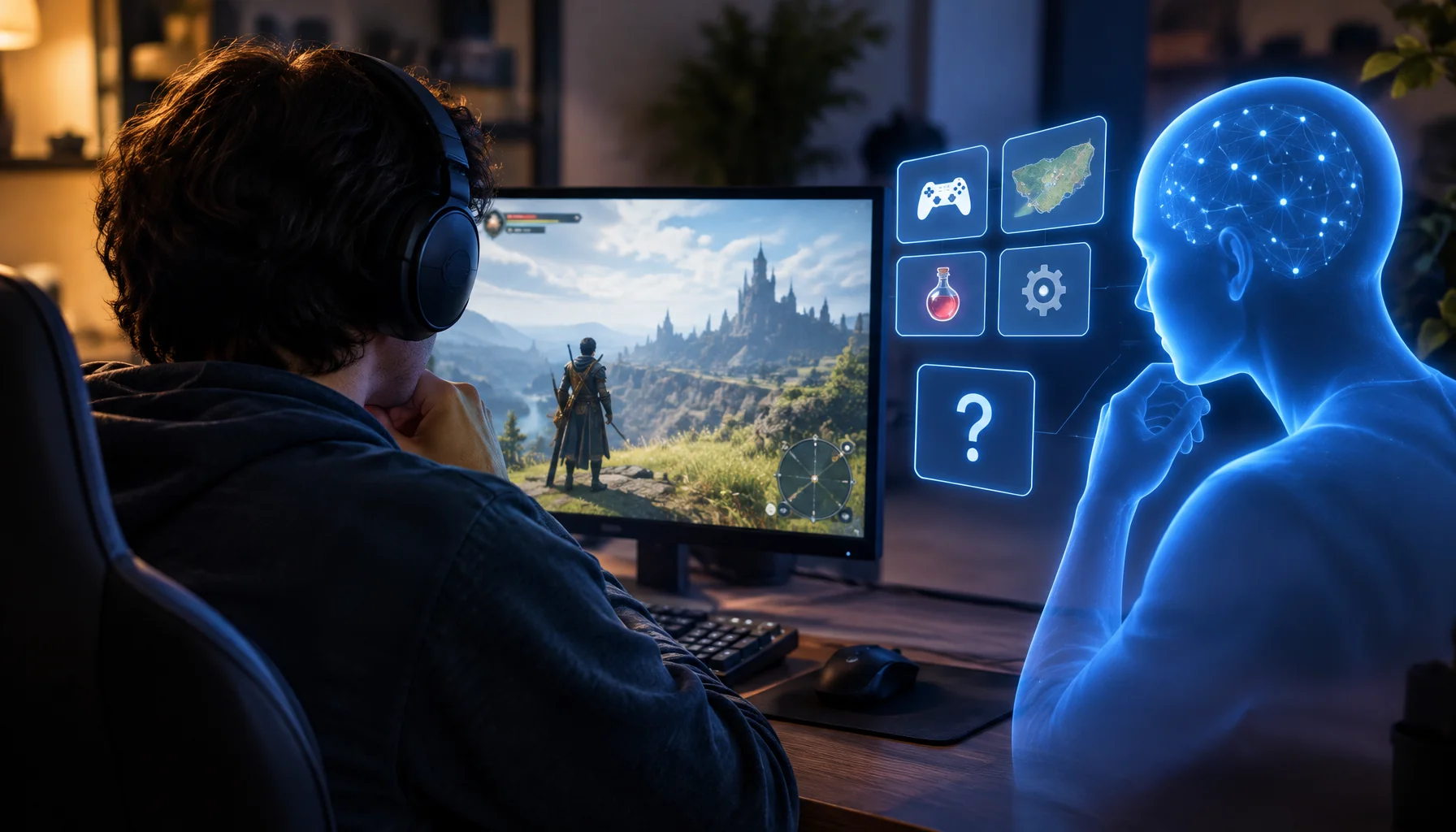
A game assistant can know the mechanics, understand the patch and still give bad advice because it does not know the state of your actual run. Your health, inventory, cooldowns, quest flags, position, party composition, difficulty, active effects and mission progress can all change what the correct next move is.
Game knowledge and game state are different things
General game knowledge tells you what can happen: an ability has a cooldown, an enemy resists a damage type, a quest requires a flag, a route contains a hazard, or an item synergizes with a build.
Game state tells you what is true now: the ability is still on cooldown, the enemy is enraged, the quest flag is already set, the shortcut is unlocked, the player has 12 percent health, or the required item was consumed five minutes ago.
A recommendation can be correct at the knowledge layer and wrong at the state layer.
Game engines already treat state as first-class information
This distinction is not artificial. Epic's Unreal Engine documentation separates Game Mode from Game State and Player State. Game State tracks information that changes during play and must be available across the session, while Player State tracks information associated with individual players.
Unreal's Gameplay Tags provide another example. Tags can represent current conditions such as movement state, capabilities, events or other flags, and gameplay logic can evaluate whether particular tags are present before allowing an action.
The important lesson for AI assistants is simple: the game itself often makes decisions from explicit state variables. An assistant that lacks those variables is trying to reproduce a decision with an incomplete input.
Decision-Critical State
Not every game variable matters to every question. The useful concept is Decision-Critical State: the smallest set of current variables that can change the answer to the player's specific question.
Examples of decision-critical state
| Question | Likely decision-critical state | Often irrelevant | |
|---|---|---|---|
| Boss strategy | |||
| Build decision | |||
| Quest progression | |||
| Navigation | |||
| Spend-or-save decision |
The Game-State Completeness Test
Check whether the assistant has enough state to answer
Why screenshots help — and why they are not enough
A screenshot can expose health, inventory, location, UI markers and visible status effects. That is valuable because it converts hidden user context into observable evidence.
But a screenshot is only a projection of state. It may not show cooldowns, hidden quest flags, server variables, current difficulty modifiers, recently consumed resources, player skill settings or what happened immediately before the image was captured.
The right question is therefore not “Can the AI see the screen?” but “Does the visible screen contain the state required for this decision?”
A save file is more complete — but still not automatically sufficient
A structured save can expose far more than a screenshot: inventory, progression, flags, unlocked locations, character stats and persistent choices.
Even then, the save may not contain transient combat state, live server configuration, matchmaking conditions or information that exists only in memory during the current session.
For live advice, the assistant may need a combination of persistent state and transient state.
Persistent state vs transient state
| State type | Examples | Typical lifetime |
|---|---|---|
| Persistent | Quest progress, unlocked areas, inventory, skill tree, story choices | Survives save/load |
| Session | Current lobby, run seed, active mission, temporary world state | Current play session or run |
| Encounter | Health, enemy phase, cooldowns, buffs, position | Seconds to minutes |
| External/live | Server event, rotation, hotfix, matchmaking pool, backend rule | Controlled outside the local save |
| Derived | Estimated DPS, route efficiency, risk level, expected resource value | Computed from other state |
The most dangerous missing state is the one that changes the recommendation
Missing a cosmetic variable rarely matters. Missing one boss-phase flag can invalidate the whole strategy.
This is why completeness should not be measured by how many variables the assistant has. Ten thousand irrelevant values do not compensate for one absent decision-critical flag.
State quality is therefore about relevance, correctness and freshness rather than volume.
The State Sufficiency Matrix
How confident should the assistant be?
| Observed critical state | Missing critical state | Best response behavior | |
|---|---|---|---|
| Complete enough | |||
| Partially complete | |||
| Weak state | |||
| Unknown |
Why game assistants hallucinate state even when they know the game
Language models are good at completing plausible patterns. If a player says “I am at the second boss and low on healing,” the model may silently fill missing details from common playthrough patterns.
That can produce an answer that sounds personalized without actually being grounded in the player's state.
A reliable assistant should distinguish three categories: observed state, user-reported state and inferred state. Inferred state should never be silently upgraded into fact.
Observed, reported and inferred state
| State source | Example | Reliability issue |
|---|---|---|
| Observed | Screen/API/save shows 18 HP | Can still be stale or misread |
| User-reported | Player says the shortcut is unlocked | Usually useful but may be mistaken or outdated |
| Inferred | Assistant assumes the player has a common item at this point | Must remain an assumption unless verified |
A state-aware assistant should ask fewer, better questions
The solution is not to interrogate the player about everything. It is to identify the smallest missing state that can change the decision.
Bad clarification vs useful clarification
| Weak question | State-aware question | |
|---|---|---|
| Boss | ||
| Quest | ||
| Route |
State freshness matters
A correct state snapshot can become wrong almost immediately. Combat position, health, cooldowns and enemy phase are high-frequency variables. Quest completion or unlocked locations are comparatively stable.
The assistant should therefore attach different freshness expectations to different state classes rather than treating all retrieved context as equally current.
Patch state and player state solve different problems
Version awareness answers: “Which rules are currently active?” Player-state awareness answers: “Which of those rules matter in this exact situation?”
Both are necessary for strong advice. A perfectly current patch model can still fail if it assumes the wrong inventory or quest state. A perfect save-state model can still fail if its mechanic values belong to the previous patch.
The Game-State Integrity Check
Before trusting a personalized game recommendation
What would change this answer?
The problem becomes smaller if a game exposes authoritative, structured and current state through an API or native assistant interface. In that case the AI can resolve many decision-critical variables automatically instead of asking the player.
It becomes larger in games with hidden information, procedural systems, server-side rules, rapid combat or intentionally opaque mechanics where the assistant cannot observe the variables that drive the outcome.
Limitations
Different games model state differently. The categories in this article are a diagnostic abstraction, not a claim that every game engine stores these variables in the same architecture.
Even complete state does not guarantee correct advice. The assistant can still reason badly, misunderstand mechanics or optimize for the wrong player objective. State completeness removes one failure source; it does not prove the conclusion.
Conclusion
A gaming AI can know the entire wiki and still fail the player standing in front of it because general knowledge is not the same thing as current state.
The reliable path is to identify the decision, resolve the small set of state variables that can change the answer, separate observed facts from assumptions, and respect freshness. The question is not “How much context does the assistant have?” It is “Does it have the state required for this decision?”
FAQ
Game-state-aware AI assistants
Why can AI know a game well and still give bad advice?
Is a screenshot enough for personalized game advice?
Does an AI need the entire save file?
What is decision-critical state?
Can perfect game state guarantee a correct answer?
Glossary
Key game-state terms
- Game state
- The current set of variables that describe what is true in the active game or session.
- Decision-Critical State
- The minimum current state whose values can change the answer to a specific player decision.
- Persistent state
- State such as progression, inventory or story choices that normally survives save/load boundaries.
- Transient state
- Short-lived values such as health, cooldowns, position or active effects that can change rapidly.
- Game-State Completeness Test
- A Figure Rocks framework for checking whether an assistant has enough relevant, current state to make a valid recommendation.
Primary sources
Epic Games — Game Mode and Game State in Unreal EngineOfficial Unreal Engine documentation describing Game Mode, Game State and player-related session information.
Epic Games — Gameplay Framework Quick ReferenceOfficial reference explaining how GameState and PlayerState track current game and player information.
Epic Games — Using Gameplay TagsOfficial documentation showing how current conditions and flags can be represented and evaluated in gameplay logic.
Epic Games — Gameplay Attributes and EffectsOfficial documentation showing how numerical current-state properties such as health, strength and movement speed can drive gameplay.
Figure Rocks — When Gaming AI Sounds Right but Isn'tInternal article on reasoning failures in game assistants and agents.
Figure Rocks — Patch Notes Are Not Game StateInternal article on version, branch, platform and live-service validity.
Related Articles
Stutter Fixes: The Order That Actually Reduces Frametime Spikes
Stutter fixes work when you match the stutter type. Use the correct order: identify, stabilize, then optimize — not the other way around.
Fix Network: How to Restore Stable Online Play in Games
Network problems in games are often misread as generic lag. This guide explains how to separate real online instability from local timing issues, diagnose what is actually wrong, and fix the network in the right order.
Stutter Fix Order: What to Change First (So You Don’t Waste Time)
Stutter is a symptom. The fix order matters: triage, stabilize pacing, then tune VRR and graphics. Here’s the practical sequence that works.
Fix Input Lag Fast: The No-Placebo Checklist (Display, Timing, Background Load)
Stop guessing. This checklist isolates the real causes of input lag: display processing, unstable timing, and background load — in the right order.
Fix Stutter: How to Restore Stable Frame Delivery in Games
Stutter is not one problem and it does not have one fix. This guide explains how to identify the pattern, separate common causes, and restore stable frame delivery without wasting time on random settings.
Fix Input Lag: What Actually Improves Feel in Games
Input lag is rarely one setting and almost never one simple cause. This guide explains where delay actually builds up, how it affects feel, and the practical fix order that improves responsiveness without placebo.