
NVIDIA RTX Spark Puts DLSS 5 and Local AI Characters on the Same Gaming Platform
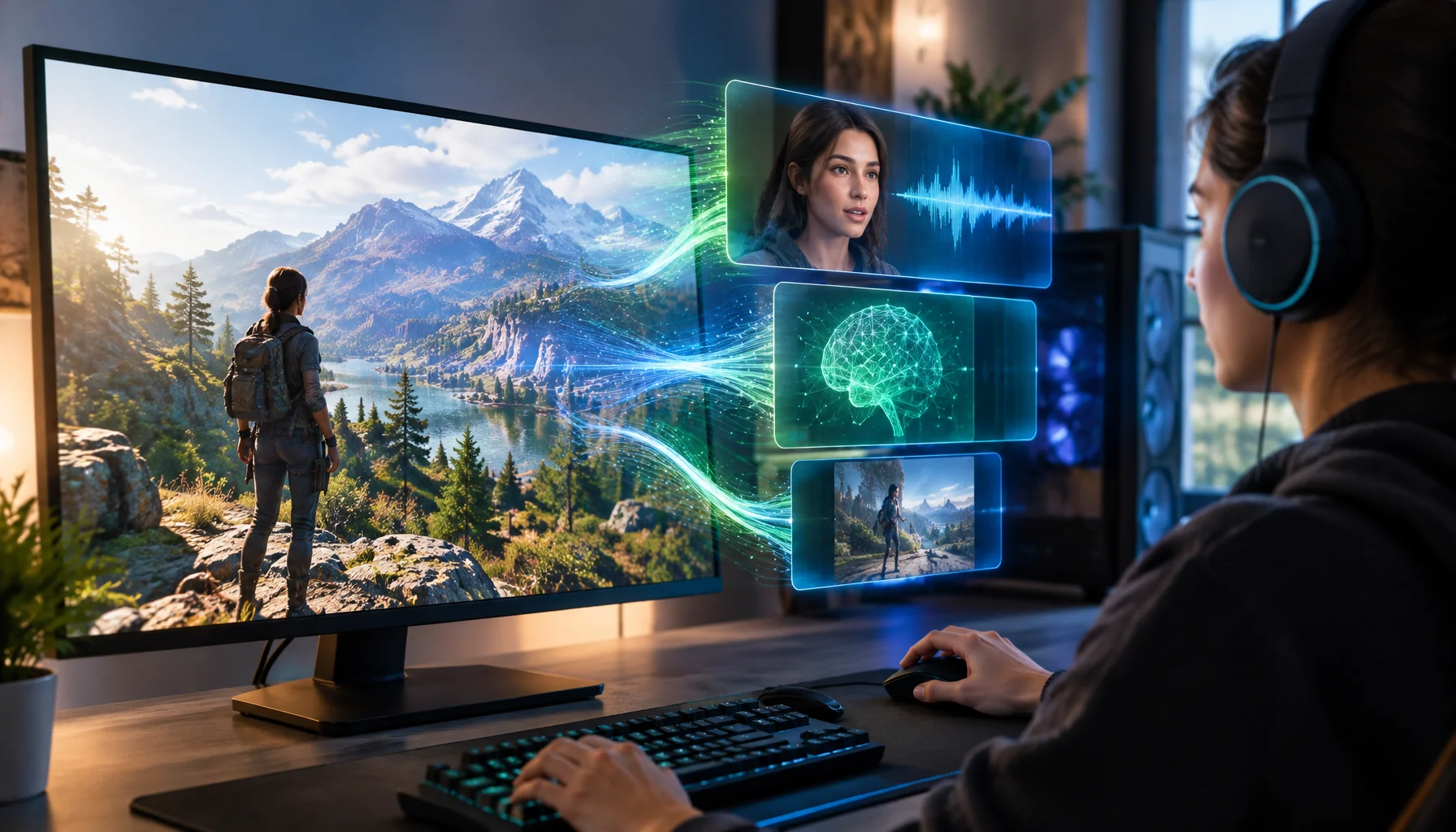
On October 27, 2026, NVIDIA positioned RTX Spark as more than a new Windows PC platform. The company is bringing two different kinds of AI workload onto the same gaming machine: neural rendering through DLSS 5 and local character intelligence through NVIDIA ACE and Nemotron 3.5 Bolt E4B 4GB.
That combination is the real news. Games are beginning to use local AI not only to reconstruct or generate pixels, but also to interpret player intent, reason over game state, call tools and drive character behavior. The technical challenge is no longer only whether a model can run. It is whether graphics, speech and agent inference can share memory, compute and latency budgets without damaging the game itself.
Direct answer
RTX Spark is NVIDIA's new Windows PC platform for AI development, creation and gaming, built around a Blackwell RTX GPU and Grace CPU with up to 128 GB of unified memory. For games, NVIDIA is pairing that platform with DLSS 5, RTX Kit, Unreal Engine 5.8 support and a new small language model, Nemotron 3.5 Bolt E4B 4GB, designed for local AI characters.
The most important architectural change is that neural graphics and game-agent reasoning are becoming concurrent workloads. A future game may use one AI path to improve the rendered image while another model listens to the player, reads relevant state, reasons about a request and selects an allowed game action.
What NVIDIA announced on October 27, 2026
NVIDIA says RTX Spark combines up to 128 GB of unified memory with the CUDA software stack, ray tracing and the full DLSS suite. The gaming stack also includes RTX Kit technologies, Nsight development tools, an RTX Branch of Unreal Engine 5.8 and the In-Game Inferencing SDK used to run local language and speech models.
The character-side update centers on Nemotron 3.5 Bolt E4B 4GB. NVIDIA released the model itself on October 23, then highlighted its gaming role four days later. The model is available to developers through the In-Game Inferencing SDK and is optimized for conversational agents that need to run locally while leaving resources available for the rest of the application.
On the rendering side, DLSS 5 with 3D-Guided Neural Rendering is supported on RTX Spark, beginning with NBA 2K27. NVIDIA says its October DLSS 5 model update runs twice as fast as the September version, halves GPU overhead and uses 20% less VRAM at 4K while maintaining comparable visual fidelity. Those are NVIDIA's measurements and should be treated as manufacturer performance claims until independently tested.
The real shift: the gaming PC becomes a shared AI runtime
Local game AI has a harder constraint than a desktop chatbot: it does not own the machine. The game is already consuming GPU time, memory bandwidth, VRAM or unified memory, CPU time, storage bandwidth and frame-time budget. Speech recognition and text-to-speech can add another layer of competition.
That makes efficiency per gigabyte more important than raw model size. NVIDIA describes Nemotron 3.5 Bolt E4B as fitting into roughly 4 GB for its target workloads so that local character inference can coexist with graphics and other models. The design goal is therefore not simply a smarter NPC. It is a model that can remain useful while the game is still rendering.
This is also why RTX Spark matters as a platform story rather than as a single-model announcement. Neural rendering, language reasoning, speech and traditional game logic are converging on the same machine, but they still have different timing requirements and different authority over the game.
What Nemotron 3.5 Bolt adds to local game characters
Nemotron 3.5 Bolt E4B 4GB is built for conversational and agentic workloads rather than frame-by-frame control. NVIDIA lists autonomous multi-turn tool use, instruction adherence, configurable reasoning and grounding to game state among its core capabilities.
The model supports a 64K context window that can hold conversation history, instructions, tool definitions, retrieved information and game state. It also supports 35 languages, while NVIDIA says the base model was pretrained across more than 140 languages.
NVIDIA reports about 40% higher average quality than its previous model on selected relevant benchmarks and up to about 80% fewer output tokens than peer models. These numbers describe NVIDIA's benchmark results, not a guaranteed improvement in NPC believability, game latency or frame pacing.
There is also an important timeline distinction. PUBG's public-beta AI teammate uses NVIDIA's first-generation Nemotron small language model, while Aniimo demonstrated a second-generation Nemotron model. Nemotron 3.5 Bolt is the new developer model announced now; NVIDIA has not said that those existing implementations have already migrated to it.
Figure Rocks already examined that separation in PUBG Ally Shows Why AI Teammates Need Two Brains: language reasoning is useful for planning, coordination and interpretation, while fast combat reactions still belong in deterministic or specialized game-side systems.
64K context, retrieval, live state and tools are not the same thing
A 64K context window increases how much information a model can consider at once, but it does not automatically make the character knowledgeable, current or correct. Context capacity answers how much information can be supplied. Retrieval decides which external knowledge should be supplied. Live game state describes what is true in the current session. Tools define what the agent is allowed to inspect or do.
NVIDIA's ACE Game Agent SDK reflects that separation directly. Its Agent API manages stateful, multi-step tool-assisted reasoning; its Chat API gives developers lower-level control over inference; and its RAG API supports semantic, lexical and hybrid retrieval from developer-built databases. NVIDIA has already demonstrated that retrieval architecture in the experimental Total War: PHARAOH advisor, which queries more than 1,200 interlinked game-data tables.
For a game character, those layers should stay distinct. A knowledge database may say how an item works. Current game state must say whether the item is actually present. The model may decide that using the item is sensible. A validated game-side function must still decide whether that action is legal and execute it.
Local inference also does not mean that the entire game becomes offline. The language model may run on the player's machine while multiplayer servers, account systems, downloadable content or other services still require a network connection.
DLSS 5 makes the same machine an AI rendering platform
DLSS 5 introduces 3D-Guided Neural Rendering as another stage in the graphics pipeline. NVIDIA describes it as enhancing lighting and material detail from the engine-rendered frame while preserving developer controls over what can change. The existing geometry, textures, lighting buffers and authored scene remain the foundation.
That distinction matters because neural rendering is not a replacement for the game engine. It is an inference layer operating on information the engine already provides. The same principle appears on the agent side: a language model can interpret and decide, but the game engine remains authoritative over valid state and executable actions.
The broader architecture is explored in The Game Engine Is Becoming Part Renderer, Part Scheduler, Part AI System. RTX Spark makes that convergence more concrete because rendering inference and agent inference are now being designed as workloads that must coexist on one local system.
Why RTX Spark matters to game developers
RTX Spark is not only a consumer feature bundle. NVIDIA is providing a development path around it: Unreal Engine 5.8 support for Windows on Arm, Nsight profiling tools, the In-Game Inferencing SDK and eight RTX Kit technologies covering areas such as neural texture compression, neural shaders, geometry, denoising, character rendering and global illumination.
The practical implication is that developers can increasingly profile graphics and local AI as parts of one runtime budget instead of treating AI as a remote service with separate latency and cost assumptions. That creates new possibilities, but it also makes scheduling, memory pressure and worst-case frame-time behavior more important.
What players should not assume yet
RTX Spark support does not mean that every game will suddenly contain unscripted AI characters. Developers still have to design the character, expose safe observations and actions, integrate speech or text interaction, define memory behavior and decide when model inference is worth the runtime cost.
DLSS 5 performance claims also do not prove that every supported game will feel more responsive. Higher displayed frame rates, generated frames, neural reconstruction quality and input latency are related but separate measurements. A graphics feature can improve visual smoothness without reducing every component of end-to-end latency.
Likewise, a stronger local language model does not make game behavior deterministic. Open-ended dialogue and reasoning can improve adaptability, but scripted systems remain easier to test and more predictable for behaviors where the correct response is already known.
What is confirmed, what is a manufacturer claim, and what is still unknown
Confirmed by NVIDIA: RTX Spark is a Windows PC platform built around Blackwell RTX graphics and Grace CPUs; systems can provide up to 128 GB of unified memory; DLSS 5 and the RTX gaming stack are supported; Nemotron 3.5 Bolt E4B 4GB is available to developers; the model supports 64K context, tool use, configurable reasoning and game-state grounding.
Manufacturer benchmark claims: NVIDIA reports roughly 40% higher average quality than its previous model on selected benchmarks, up to roughly 80% fewer output tokens versus peers, and an October DLSS 5 model that runs twice as fast as the September version while halving GPU overhead and reducing 4K VRAM use by 20%.
Still unknown from this announcement: the real frame-time impact of simultaneous rendering, speech and character inference across different RTX Spark systems; independent measurements of NPC response latency under game load; how many commercial games will adopt Nemotron 3.5 Bolt; and how developers will balance local AI quality against deterministic gameplay and hardware requirements.
The Figure Rocks take
The most important part of NVIDIA's October 27 announcement is not one benchmark or one AI NPC demo. It is the emerging idea of the gaming PC as a shared AI runtime. Neural graphics, speech, retrieval, reasoning and game logic increasingly compete and cooperate inside the same frame-time and memory envelope.
If that architecture works under real load, local AI characters could become less dependent on cloud round trips and more tightly connected to live game state, while neural rendering continues to consume AI compute for the image itself. That is a meaningful change in how games are built: the question shifts from whether a game uses AI to which AI workloads deserve local resources, when they should run, and what authority each one receives.
Primary sources and scope
This article is based primarily on NVIDIA's October 27, 2026 RTX Spark gaming announcement, the Nemotron 3.5 Bolt E4B 4GB research release published October 23, and NVIDIA's ACE Game Agent SDK documentation and examples.
Where NVIDIA provides performance or quality numbers, Figure Rocks treats them as vendor-reported measurements unless independent evidence is available. Product support, game adoption and runtime behavior can change as SDKs, drivers and game integrations evolve.
Related Articles
Router Checklist for Gaming: The Settings That Actually Matter
Most router tweaks don’t help. These settings do: queue management under load, stable Wi-Fi behavior, and avoiding features that add latency or instability.
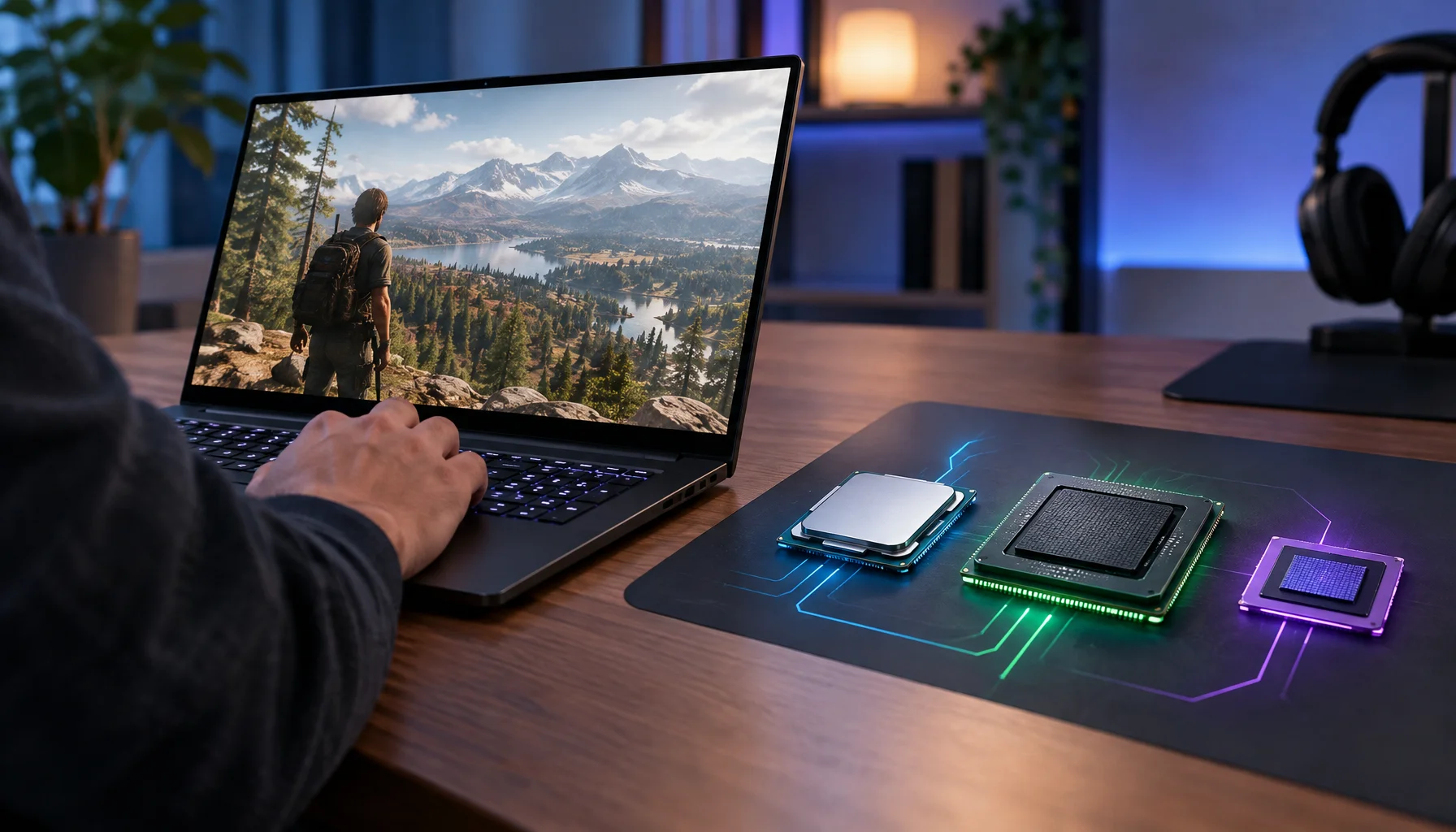
Do Gamers Need an NPU in 2027? What AI PC Hardware Actually Changes in Games
AI PCs increasingly combine a CPU, GPU and NPU, but those processors do very different jobs in games. This guide explains which gaming AI workloads actually use an NPU, when the GPU still matters more, and how to avoid paying for the wrong kind of future-proofing.
Background Load Kill Switch: Stop Overlays, Sync, and Scans From Ruining Feel
If feel changes day-to-day, background load is a prime suspect. Use this kill-switch checklist to remove the usual culprits and stabilize frametimes.
Router Checklist for Gaming: The 10 Settings That Actually Matter
Most router tweaks are noise. Use this checklist to target stability under load: Wi-Fi environment, queue management, and sane defaults that reduce spikes.
Streaming Stutter: Storage, Decompression, and the Hitch Pattern
Streaming stutter is asset loading: new areas, new textures, periodic hitches. Learn the pattern, what to change first, and what upgrades actually help.
Fix Input Lag Fast (PC & Console): The No-Placebo Checklist
Stop chasing myths. This checklist targets the real causes of heavy feel: display processing, unstable pacing, render queue buffering, and background spikes.
Audio Chain for Gaming: One Clean Path from Game to Ears
Audio positioning improves when the chain is clean and stable. Build one path: one device, one mode, minimal processing, consistent levels.
Stutter Fixes That Actually Work: Stop Chasing Random Graphics Tweaks
Most stutter ‘fixes’ fail because they don’t match the stutter type. Use this practical order: triage, reduce spikes, stabilize pacing, then tune settings.
Motion Clarity for Gaming: Blur Sources and the Fix Order That Works
Motion clarity isn’t one setting. Blur comes from multiple sources. Use this fix order to improve readability without adding latency or artifacts.
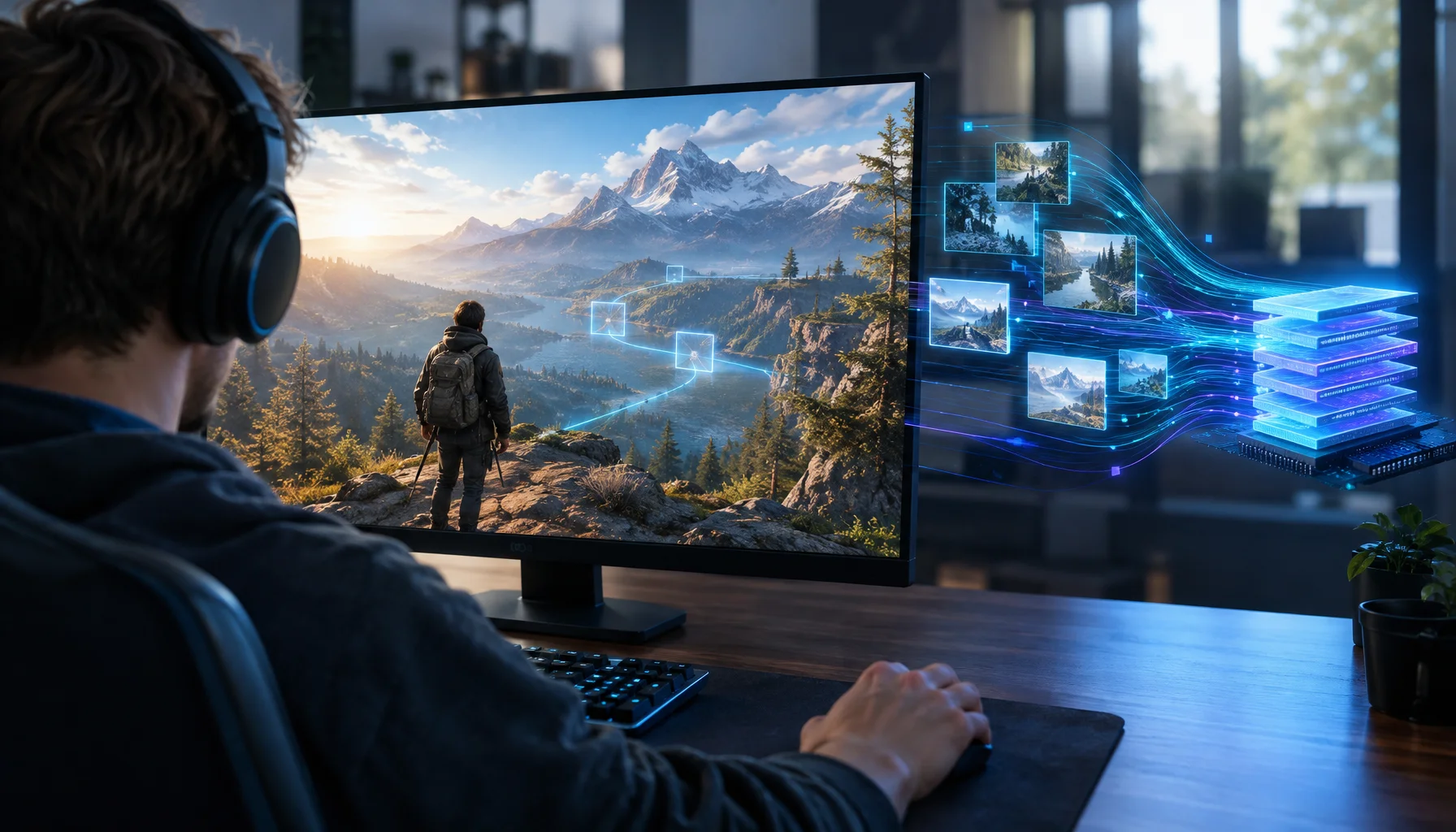
What If a Game Could Predict Its Next Memory Access? AI Prefetching and the Future of Stutter
Game engines already know where the player, camera and world are going. Research shows learned GPU prefetching can predict memory pages. What happens if those ideas are combined?
TV Local Dimming Tuning for Games: Keep Detail Without Flicker
Local dimming can improve contrast or ruin stability with pumping and crush. Use this practical tuning order to keep detail and readable highlights without flicker.
VRR Range Basics: Why the Same Setup Feels Great in One Game and Bad in Another
VRR isn’t magic. If your FPS lives outside the VRR range, feel becomes inconsistent. Learn range basics, edge bouncing, and how to stay stable.