
PUBG Ally Shows Why AI Teammates Need Two Brains: Fast Reflexes and Slow Reasoning
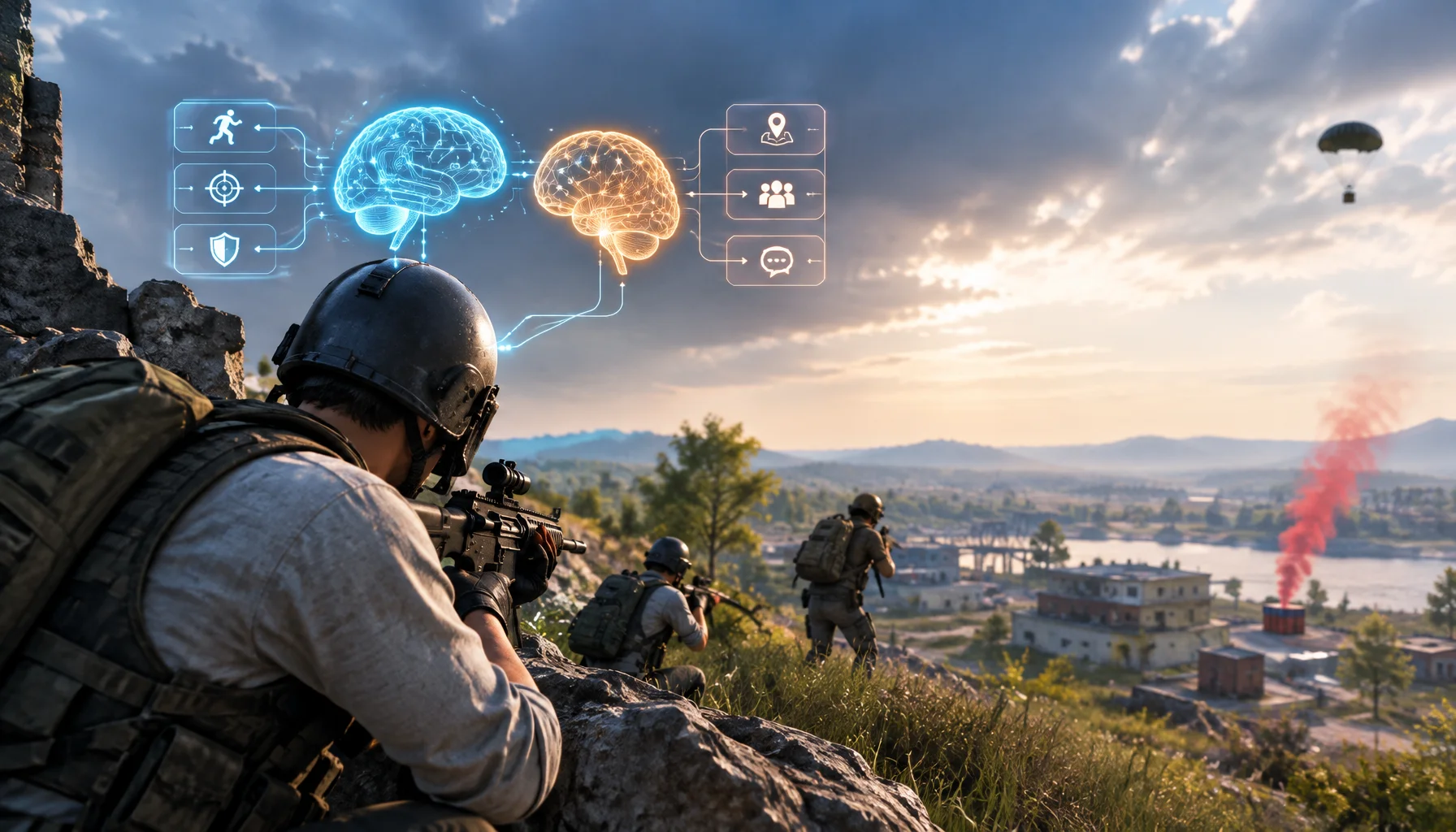
A language model can talk about a firefight, but it should not be responsible for every movement, aim adjustment and split-second reaction inside one. NVIDIA ACE and KRAFTON's PUBG Ally show why useful AI teammates need more than a single model: fast gameplay control and slower language reasoning are different jobs.
Why one AI model should not run the whole character
A modern game character has to solve several problems at radically different timescales.
It may need to avoid an obstacle in milliseconds, react to nearby gunfire, follow a player command, decide whether to loot, explain a plan in natural language and remember what the player asked earlier.
Trying to force all of that through one language-model loop creates a timing mismatch. The model is good at semantic reasoning and planning, but real-time control often needs deterministic logic that can react every game tick.
PUBG Ally uses a two-speed architecture
KRAFTON describes PUBG Ally as a co-playable AI teammate powered by NVIDIA ACE. The system combines player voice, live match state, a small language model and game-side control logic.
According to NVIDIA's technical deep dive, the architecture separates a System 1 behavior tree from a System 2 language model. The behavior tree handles fast reactive gameplay such as movement and combat, while the language model handles deliberate reasoning, communication and coordination.
That split is one of the most important design patterns in real-time game AI because it gives each subsystem authority over the work it is actually suited to perform.
The Two-Speed Game Agent model
How a practical AI teammate can divide the work
System 1 vs System 2 in a game agent
| Fast reactive layer | Deliberate reasoning layer | |
|---|---|---|
| Timescale | ||
| Typical tasks | ||
| If it is too slow | ||
| Best control style |
Live game state is what makes the model useful
The PUBG Ally model does not reason from dialogue alone. NVIDIA says the game engine exposes live match state to the agent through observation tools represented as textual descriptions.
That matters because a teammate needs to know what is happening now: what the player said, what items exist nearby, where danger is coming from and whether the previous plan is still valid.
This is the same reliability principle that applies to any game assistant: general game knowledge is not enough when the correct action depends on current session state.
The Action Authority Boundary
A useful real-time game agent needs a clear boundary between what the model may decide and what the game engine may actually execute.
The model can choose a goal such as “move to cover,” “loot ammunition,” “follow the player” or “engage that enemy.” The game-side controller should then translate that intent into legal, bounded actions that obey navigation, animation, cooldowns, physics and game rules.
Good vs dangerous agent control
| Bounded architecture | Unbounded architecture | |
|---|---|---|
| Movement | ||
| Combat | ||
| Inventory | ||
| Speech |
Why event-driven reasoning beats constant language-model polling
PUBG Ally's model loop is described as event-driven. It can be triggered by the player speaking or by relevant in-game events.
That is more efficient than asking the model to rethink the entire world on every frame. Most frames do not require a strategic decision.
A good trigger system calls the language model when semantics matter: a new order arrives, a threat changes the plan, an objective is completed, an item becomes relevant or the current plan fails.
The Decision Trigger Filter
When should the language model wake up?
On-device inference changes the design space
NVIDIA ACE is designed around on-device inference as well as cloud options. For PUBG Ally, NVIDIA says the small language model runs locally on the player's GPU.
The published architecture uses a 2B-parameter Mistral-NeMo-Minitron model designed to fit into the VRAM headroom remaining after PUBG itself is running.
That is a non-trivial constraint. Game AI cannot simply consume all available GPU memory or compute because the graphics workload still has priority.
AI inference now competes with rendering
This creates a new resource problem for games: graphics and AI inference may share the same GPU.
NVIDIA's In-Game Inferencing SDK is designed to schedule local AI models alongside graphics workloads. Its purpose is not only to run models, but to do so without destroying the game's frame-time budget.
That means future performance reviews may need to measure not only DLSS, ray tracing and VRAM use, but also the cost of local NPC inference.
The Game AI Resource Budget
| Resource | Graphics needs it for | AI agent needs it for |
|---|---|---|
| VRAM | Textures, buffers, geometry, ray tracing, frame generation | Model weights, KV cache, embeddings and inference buffers |
| GPU compute | Rasterization, RT, neural graphics | SLM/ASR/TTS inference |
| CPU time | Simulation, draw submission, game systems | Agent orchestration, tools, text processing |
| Memory bandwidth | Asset and render workloads | Model execution and data movement |
| Frame-time headroom | Smooth presentation | Low-latency inference without visible stutter |
Why small models make sense inside games
A game agent does not need to know everything on the internet. It needs to understand the game's vocabulary, current state, action tools and a limited set of relevant knowledge.
That is why NVIDIA ACE emphasizes small models optimized for gaming hardware. KRAFTON also describes domain adaptation for PUBG Ally: the model was constrained to the Sanhok map and AI Duo context and trained around PUBG-specific concepts and tool use.
A smaller specialized model can be more useful than a much larger general model if its world, tools and action boundaries are well defined.
RAG and tools solve different problems
NVIDIA's ACE Game Agent SDK exposes Agent, Chat and RAG APIs. Those are separate capabilities because knowledge retrieval and action execution are not the same thing.
RAG can provide grounded game knowledge such as item rules, faction data or mechanics. Tools expose what the agent can observe or do in the live game.
An agent can retrieve the correct fact and still fail if it has the wrong live state or invokes the wrong action. Knowledge, state and action authority all need separate validation.
What traditional NPCs still do better
Language-model agents are not automatically better at every NPC task.
Scripted logic is cheaper, easier to test and more predictable when the desired behavior is already known. A door guard who has three fixed states does not need an agentic reasoning loop.
The strongest use cases are situations where natural language, broad planning, contextual adaptation or player-specific coordination create value that static logic struggles to provide.
When to use scripted AI vs agentic AI
| Traditional/scripted AI | Agentic AI | |
|---|---|---|
| Predictability | ||
| Open-ended language | ||
| Unexpected player intent | ||
| Reflex actions | ||
| Deterministic QA |
The Agent Reliability Loop
What should happen before and after every meaningful agent action
Why natural speech makes errors more convincing
ACE can combine automatic speech recognition, language reasoning and text-to-speech so a teammate can hear, act and speak naturally.
That improves immersion, but it also increases the need for grounding. A confident spoken sentence such as “I picked up the med kit” sounds authoritative even if the item interaction failed.
Speech should therefore report confirmed state wherever possible, not merely the model's intended action.
Multilingual game agents are becoming practical
NVIDIA expanded ACE in 2026 with multilingual on-device models for language, speech recognition and speech synthesis.
NVIDIA's May 2026 developer update describes Qwen 3.5 4B support across 201 languages and dialects, Riva Parakeet TDT 600M speech recognition for 25 languages and Chatterbox Multilingual 500M voices across 24 languages.
That broadens the design space for AI companions beyond English-only demos and makes local language interaction a realistic product feature.
What would change this answer?
The architecture could become more unified if future models achieve deterministic sub-frame action latency while remaining small enough to run continuously beside graphics workloads. Today, separating reflex control from semantic reasoning remains the more practical design.
Specialized neural control policies may also replace some traditional behavior-tree functions, but the need for explicit action authority, state validation and fast execution will remain.
Limitations
PUBG Ally is one implementation, not proof that every game should adopt the same architecture. Different genres have different latency, determinism, hardware and gameplay requirements.
The public architecture details are also primarily provided by NVIDIA and KRAFTON. They are useful for understanding the implemented system but should not be treated as independent performance benchmarking.
Conclusion
The future of game agents is unlikely to be one giant model replacing the game AI stack.
PUBG Ally points toward a hybrid architecture instead: language models interpret intent and make high-level decisions; deterministic controllers execute fast gameplay; live state keeps the model grounded; and the game engine retains authority over what can actually happen.
The winning design is not the agent that thinks about everything. It is the agent that knows what it should think about—and what should stay in the game loop.
FAQ
AI teammates, NVIDIA ACE and game agents
Does PUBG Ally use one AI model to control everything?
Why not let an LLM control movement directly?
Does PUBG Ally run in the cloud?
How does the AI know what is happening in the match?
What is the ACE Game Agent SDK?
Will AI agents replace scripted NPCs?
Glossary
Key game-agent terms
- System 1 control
- Fast reactive game-side logic used for immediate actions such as movement, combat and navigation.
- System 2 reasoning
- Slower deliberate reasoning used for planning, player intent interpretation, coordination and conversation.
- Two-Speed Game Agent
- A Figure Rocks model that separates reflex-level game control from higher-level model reasoning.
- Observation tool
- A game-side interface that exposes selected current state to an AI agent in a structured or textual form.
- Agent harness
- The orchestration layer connecting model inference, observations, tools, memory, retrieval and game-side execution.
- NVIGI
- NVIDIA's in-game inferencing framework for running and scheduling local AI models alongside game graphics workloads.
Primary sources
NVIDIA Developer — How KRAFTON Built PUBG AllyOfficial technical deep dive covering the System 1 behavior-tree / System 2 SLM architecture, live game-state observations, on-device inference and domain adaptation.
NVIDIA Developer — ACE for GamesOfficial ACE overview covering the Game Agent SDK, Agent/Chat/RAG APIs, on-device models and autonomous game-character use cases.
NVIDIA Developer — Build On-Device AI CompanionsOfficial June 2026 article introducing the Game Agent SDK, Unreal Engine plugins and on-device AI companion architecture.
NVIDIA GeForce — PUBG Ally Duo Mode BetaOfficial article describing PUBG Ally as a collaborative autonomous AI teammate and the evolution of ACE beyond conversational NPCs.
NVIDIA Developer — Multilingual AI CharactersOfficial May 2026 update describing multilingual on-device ACE models for language, ASR and TTS.
Related Articles
Lucas - number 53
The Lucas amiibo from the Super Smash Bros. Series represents the playable fighter as he appears in Super Smash Bros. for Nintendo 3DS and Wii U. It is an NFC-based character figure that interacts with compatible Nintendo systems. The practical value lies in storing fighter data and unlocking small in-game extras where supported.
Inkling - number 64
The Inkling amiibo from the Super Smash Bros. Series expands gameplay primarily through its function as a trainable Figure Player. It is not decorative alone. It stores data, adapts in battle, and becomes a persistent opponent. Released in December 2018 alongside Super Smash Bros. Ultimate for Nintendo Switch, it represents the Inkling fighter as introduced to the Smash roster.
Resetti
The Resetti amiibo belongs to the Animal Crossing amiibo figure line released during the early expansion of Nintendo’s NFC-based character figures. Like others in this series, the figure functions as a physical representation of a character combined with a small NFC chip that communicates with compatible Nintendo systems. When scanned, the figure links the character Mr. Resetti to supported games and unlocks small interactions or character appearances tied to his role in the Animal Crossing universe.
Tom Nook
Within the Animal Crossing amiibo figure line, the Tom Nook amiibo represents one of the central figures of the series. The figure appeared during the first wave of dedicated Animal Crossing amiibo. Release timing varied slightly by region, but broadly falls into November 2015. The figure carries the likeness of Tom Nook, a character who has been present since the earliest Animal Crossing titles and whose role has slowly shifted from shopkeeper to infrastructure organizer of village life. The amiibo functions primarily as a character key: scanning it places Tom Nook into several compatible Nintendo games, unlocking small interactions, character content, or themed bonuses.
Banjo & Kazooie - number 85
The Banjo & Kazooie amiibo from the Super Smash Bros. Series represents the duo as they appear in Super Smash Bros. Ultimate. It is an NFC-enabled figure with storage capability. In simple terms: a physical character model that can save and transfer fighter data when used in compatible software. Not decorative only. It holds progress.
Piranha Plant - number 66
The Piranha Plant amiibo from the Super Smash Bros. Series extends the functionality of the character beyond the screen. It stores data, develops behavior patterns in compatible titles, and unlocks specific in-game content. In practical use, it acts as a physical save medium for a trainable fighter and as a key for small bonuses in various Nintendo games.
Kapp’n
The Kapp’n amiibo belongs to the Animal Crossing amiibo figure line released during the first wave of figures connected to the series. Like other figures in that line, it carries a small NFC chip that links the physical object to several Nintendo games. Scanning the figure activates character-related content. The practical value of the figure sits mostly in the ability to call Kapp’n into supported titles and unlock small pieces of themed content connected to his role in the series.
Pokémon Trainer - number 74
The Pokémon Trainer amiibo from the Super Smash Bros. Series represents the trainer character as seen in Super Smash Bros. Ultimate. It is a functional NFC figure that stores data and interacts with compatible Nintendo games. In practical terms, it is a training partner that adapts over time. Not a decorative object only, but not a complex device either. It does what the amiibo system was built to do.
120Hz Feels Worse? Diagnosis Checklist (Wrong Mode, VRR Range, Caps)
Higher refresh can expose instability. Use this checklist to diagnose why 120Hz feels worse: wrong mode, wrong refresh path, VRR range issues, or missing caps.
Ivysaur - number 76
The Ivysaur amiibo from the Super Smash Bros. Series represents the middle evolution of the classic Grass type Pokemon within Nintendo’s crossover fighting line. It is a physical NFC figure that can be scanned into compatible games. In practical terms it stores data, learns through play and unlocks defined in game elements depending on the software used. No mystery behind it. It is a training tool, a collectible and a functional accessory.
Dark Samus - number 81
The Dark Samus amiibo from the Super Smash Bros. Series extends the playable fighter into a physical training unit. It is not a decorative object alone. It stores data, develops behavior patterns in compatible titles, and reflects match history back into the game. Its added value lies in this persistence. The figure becomes an adaptive opponent rather than a static unlock.
Kicks
The Kicks amiibo belongs to the Animal Crossing amiibo figure line released during the early expansion of Nintendo’s NFC figure ecosystem. Like the other characters in this series, the figure functions as a physical key that connects to compatible Nintendo games through NFC. When scanned, the amiibo links the character Kicks to different in-game systems. The practical value is simple: it allows players to access character-specific interactions, small unlocks, or themed content depending on the supported title.